Skip to content

Contractual Dates, in the past

Dean PearcyMember for 20 years 6 months
Created
5
3
0

Could someone please give me a suggestion on how to deal with contractual milestones that are in the past as far as the Data Date is concerned?

I have a number of projects where the contract completion milestone date is now in the past, yet is not complete. The project is still contractually oblidged to complete by a date that is in the past, yet is not complete, therefore the milestone needs to reflect the correct contractual finish date. But P6 will not allow dates behind the data date unless they are actualised. We do have outstanding but unimplemented CEs that will cover us for the delay, but because these are as yet unimplemented, I con't show these in the ocntract programme yet either.

It feels wrong to actualise the milestones, so that I can make them reflect the correct date, but it also feels wrong to allow them to show an incorrect date, i.e. the data date that is holding them.

TIA.

5 replies

Oldest first
  1. 0
    Zoltan Palffy ·

    there is no Delorean there is

    there is no Delorean there is no flux capacitor you do not have 1.21 gigawatts of power. No back to the future.

    since you did not meet the milestone dates the program will forecast new dates based on the durations and the logic leading up to the milestones.

    The date date should not be holding the milestones. There should be activities that start at the date date and lead up to the milestones. The milestone should not be on the data date. Milestones are 0 day durations and as soon as their predcessors are complete they are also comeplete. 

    You are correct in that your are contractually obligated to meet the milestone dates but you have not. Now your must suffer the consequences and or provide documentation why you did not meet theses dates.

    You can do this by providing and performing a TIA time impact analysis and ask for and EOT Extension of time.  

    You need to build your case as to what prevented you from completing the milestones on time. 

  2. 0
    Dean Pearcy ·

    Thanks Zoltan,However, I

    Thanks Zoltan,

    However, I think you misunderstand me. I do have all the logic links and activities that show me what our "PLANNED COMPLETION DATE" will be, and this is correctly identified as beyond the "CONTRACT COMPLETION DATE". However, for client reporting purposes, they have a suite of compulsory milestones, coded for thier own dashboard generation, that I am required to use. One of these is Contract Completion Date. Hence my problem. I can't leave this milestone to the left of the data date, to allow it to report it's correct date, without actualising it, but if I do actualise it, it is contractualy false. 

    My problem is how do I feed a dashboard, with a milestone that is ultimately going to report the wrong date?

  3. 0
    Rodel Marasigan ·

    You can use UDF milestone

    You can use UDF milestone date for your report to feed the client dashboard.

  4. 0
    Zoltan Palffy ·

    I think that their dashboard

    I think that their dashboard needs to be revised but in the eman time you can use Rodel' s solution of created UDF fields

    This largely depends on what the dashboard reads to get the date 

  5. 0
    Rafael Davila ·

    Deadline Markers In Primavera

    Deadline Markers In Primavera P6 EPPM

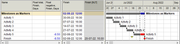
    Using-Deadline-Markers-In-Primavera-P6-EPPM-Fig-11  please hover thumbnails and click for a better view.

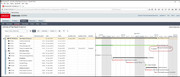
    We simply show constractual constraint markers as follows. We also show FNL dates on a column as well as constrained float values and non constrained float values. We pay attention to contractual milestones as well as to non constrained float values.

    2022-06-23-19-55-24-Gantt-diagram-settings

    2022-06-23-20-21-59-Activity-Gantt-Milestones-01-1-Milestones-as-Markers

    We do not pay attention to negative float values that can be difficult if not impossible to understand in resource leveled schedules, but some clients ask for such calculation so we provide them with the numbers they ask.

    Float & Constraints: Jargon - Part 2 : Fieldstone Construction Delay Analyst

    Negative Float: A contradiction in terms, which hides the true value of activity float. Float is the extra time available to complete an activity and is best expressed as a positive value. Negative float comes about when the project completion date is imposed on the network. When the project is in delay, the amount of the delay is subtracted from the float. This often, but not necessarily, gives a negative value. Negative float hides the true value of activity float and makes the assessment of relative delay between activities more difficult.

    If a programme displays negative float it would be better if the true, positive, value was also shown. This would better display where the activity lies relative to other project activities.

    Please be reminded that if criticality is not well defined in the contract then negative float can determine the entitlement to compensability in concurrent delays.

    • AACE International Recommended Practice No. 49R-06: Negative Total Float - One of the competing legal applications of concurrent delay says that delay to any work exhibiting negative float that occurs independently and at the same time as another delay may be considered a concurrent delay. The reasoning is that but for the other delay not occurring, then delay to the activity with negative float (and not necessarily the lowest float) would have delayed the project as well. In this case, negative float is used as qualifying criteria for project delay consideration. While this definition of a critical path (and thus concurrent delay) is not as universally used as the concept of lowest total float, it must be considered if the contractual language defines it as the technique to be used.
       

Log in or join to reply

ProjectControls.com is free to join. Members can post questions, reply, vote and follow discussions.

Existing members: your original username and password still work. Forgot password?