
Difference between Retain Logic and Override Progress
- Created
- 60
- 13
60 replies
Oldest first- 0ZPZoltan Palffy ·
it is exactly as it states.
it is exactly as it states. Retained logic when an activity have started RETAINIED LOGIC IGNORES THE ACTUAL START DATE AND LOOKS AT THE REMAINING WORK OF THE PREDECESSOR AND WILL NOT PERMIT THE REMAINING WORK OF ITS SUCCESSOR TO BEGIN UNTIL THE PREDECESSOR HAS BEEN COMPLETED.
If you use progess override it will do just that it will not honor the logic and it si possible that activities will be scheduled to be completed sooner than physcially possibel. i.e. I have an example that show drywall finishing PRIOR to stud which is physcially impossible. Also all float values will be incorrect.
If you give me your email address I can send you my write up and example.
- 0RDRafael Davila ·
Iyke,How Retained Logic,
Iyke,
How Retained Logic, Actual Dates, and Progress Override Deal With Out-Of-Sequence Progress
- Ultimately, it’s our recommendation that instead of relying on the Progress Override and Actual Dates options to deal with activities that progress out of sequence, owners should specify the use of the Retained Logic option and require contractors to address activities that progress out of sequence on an activity-by-activity basis as it occurs and to make appropriate changes to the schedule logic to ensure that the project schedule matches the current construction.
This is so true, a no-brainer broken logic can create all sort of schedule problems; unfortunately some owners might insist in hijacking your schedule and will not let you make changes in logic to your update schedules unless approved after a reluctant review.
- A revised Baseline once approved might represent an implicit change order but not so a schedule update.
- Schedule updates are essentially informative and shall always represent your true plan; if there is out-of-sequence logic it is a faulty model that might create calculation errors.
- If the update shows you are far from contract target(s) then the owner might require you to submit a recovery schedule.
- In no way the owner shall prevent you from having your plan. You are the owner of the means and methods (unless it is a Construction Management Contract) . You have the right to make adjustments to your work plan as need be.
- Why this happens is a mystery to me, perhaps lack of understanding by the owner, perhaps it is because of claims paranoia, but it happens.
Best Regards,
Rafael
- 0ZPZoltan Palffy ·
f you use progess override it
f you use progess override it will do just that it will not honor the logic and it si possible that activities will be scheduled to be completed sooner than physcially possibel. i.e. I have an example that show drywall finishing PRIOR to stud which is physcially impossible. Also all float values will be incorrect.
- 0AIAnoon Iimos ·
For me, the only difference
For me, the only difference between "Retained Logic" and "Progress Override" is misconception. "Retained logic" is just an illusion until realized. An illusion that is not corrected or rectified is stupidity or insanity. While "Progress Override" is just one of the tools or means to correct or rectify the schedule (if you know how to use it). Again, "Out-of-Sequence Activities" do not or never happen in actual construction (otherwise, all your site engineers, methods engineers and quality control engineers are stupid). Out-of-sequence activities only happen in your computer or on your schedule (or samples) which is just an illusion in the first place. Actual progress were based on facts! - 0AIAnoon Iimos ·
Apologies if I'm personally
Apologies if I'm personally pissed-off with most (if not all) literatures pertaining to the subject / topic; and making mandatory recommendations presuming that they never make any mistake. Please let me challenge everyone of you to walk through your construction sites (assuming that you know all your planning & scheduling even without looking on print outs or your computer), and pin-point any out-of-sequence activity that you can see and penalize all your field personnel for not following your sequencing-logic (as planned). If you are able to see even one activity that you think is out-of-sequence, then for me, you have all the right to insist on using "Retained Logic" only in All Schedules! And punish all your field personnel and engineers as they are all stupid! Otherwise, if you know the Spanish term "Delicadeza", then I guess you already know what to do. - 0VLVladimir Liberzon ·
Anoon,in resource-constrained
Anoon,
in resource-constrained schedules the choice of the wrong activity competing for the same resources may lead to large delays. We consider this out of sequence and insist on following the optimal order created by the scheduling tool.
Another case is starting the construction before the drawings were approved. This is risky but usual.
If out of initial sequence was analyzed and approved then it is fine. In other case it may create problems that can be avoided.
- 0AIAnoon Iimos ·
Vladimir, You missed to
Vladimir, You missed to mention that sometimes contractors were even doing construction works even without a plan or schedule (whether or not approved). And most of the time (again, if not all the time), contractors or specifically, site engineers and construction foremen do not or never follow an approved schedule or plan (and that's a reality as old as construction). Why? First, let me ask everyone (or all schedulers and planners), have you ever seen a construction foreman on site holding your approved schedule while executing the works? Well, for "resource constrained schedules", it is my opinion that a contractor with common sense or let's say smart enough would never intentionally delay a schedule, but shall certainly find ways to generate more profits from the works. - 0VLVladimir Liberzon ·
Anoon,I saw. At the start of
Anoon,
I saw. At the start of the shift construction foreman gets the list of the jobs to be done and planned volumes of work. At the end of the shift he enters actual volumes and presses recalculate button. next foremen gets the list of the jobs to be done, etc. Not everywhere, not often, but still this exists.
For "resource constrained schedules": yes, contractor is interested in doing the work faster, but foremen may select one work instead of another that requires the same resources just because he does not see future consequences that are not obvious.
- 0AIAnoon Iimos ·
Vladimir, Yes, it may happen,
Vladimir, Yes, it may happen, but unfortunately I've never seen one. It's common to see field personnel holding shop drawings and perhaps method statements or their very own plans or schedules written on scratch paper or an empty pouch of cigarette. I've even saw one very experienced construction manager giving instructions to site engineers while holding a stick and writing something on the sandy ground and just kick off what he had written afterwards. No traces, just one time instruction and that's it! He rules the site without any glance on the so-called approved schedule. And he always do what he does best and delivers in time or even ahead, without any hassles. So how can you insist on "Retained Logic" when your so-called approved schedule go out-of-sequence? Given with actual progress or data which is different from your schedule or sequencing, but much better and ahead in time for example? - 0VLVladimir Liberzon ·
Anoon, you are right. It is
Anoon, you are right. It is something we warn about.
If project schedule was created in the office by some 'planner' who did not get the data and approval from site managers, when the schedule is created and used not for resource management but for management of contracts only, it will not become decision making tool.
As we discussed earlier most "planners" do not resource load their schedules, do not level project resources, do not visit construction sites. Then "out of sequence" may usually mean that the schedule is poor and must be improved.
- 0AIAnoon Iimos ·
Vladimir, The fact is
Vladimir, The fact is "schedules" were usually copied from projects to projects and usually prepared by amateurs who were perhaps able to use a software but never had any idea on how real construction is done. You are right, as perhaps they just consider "SCHEDULES" as merely a contract requirement, so for as long as you had complied with the stupid requirements or specifications for scheduling, then you are good to go! So you may wonder why "Field Personnel" never follow your schedules or your schedules always go out of sequence? For example: A certain task is called "Excavate Foundation" (as one task in your schedule). In the field, this one task may multiply to several tasks or even hundreds of tasks. First, you need to survey, stake-out, build batter-boards, prepare the equipment, prepare for safety protection, etc. etc. etc.... For MEP works for buildings for example: How can the site people follow tasks named: First Fix, Second Fix, Final Fix? Now are you still wondering why your schedules go out of sequence and STILL INSIST ON "RETAINED LOGIC"? - 0VLVladimir Liberzon ·
Anoon,I expect that we shall
Anoon,
I expect that we shall discuss the schedules created by real professionals, not amateurs. We both know that most schedules are poor and do not meet basic requirements. But PP is a forum of professional planners that can help to improve approaches and standards of project scheduling. Best practices are rare but still exist.
Resource loading itself requires detailed scheduling. Let's agree that the schedules that can be used for real management and decision making shall be resource loaded and levelled, approved and accepted by site personnel, and only in this case out of sequence may be considered as a problem.
- 0AIAnoon Iimos ·
Vladimir, Ideally yes, but as
Vladimir, Ideally yes, but as you know it will be so difficult to do that. Firstly because all projects are time and money constrained, and of course technical expertise if not rare are very expensive as well. And even tools or software for scheduling were even argued in terms of costs without even considering functionalities and end results (and this is a fact regardless how huge a certain project is), especially if your project will be involving multi-specialist subcontractors. Gathering information from various subcontractors alone can become a disaster without yet mentioning interfaces to form an overall or master schedule. So before you knew it, some of your subcontractors were already starting construction works, while perhaps others were still worrying about engineering deliverables. So my question is: How on earth you can be able to develop a fully-linked and reasonably sequenced overall schedule and insist on using only "retained logic"? - 0VLVladimir Liberzon ·
The quality of contractor's
The quality of contractor's schedule is contractor's responsibility.
Out of sequence jobs in contractor's schedule usually tell that the schedule quality is poor and it shall be revised.
But imagine the following case: you have two contractors that shall do their jobs one after another in each room of the building.
The order matters for the second contractor but not for the first. For the first contractor only resource constraints limit the number of rooms done simultaneously.
If the first contractor starts to do the rooms out of approved order it would be necessary to apply retained logic, isn't it?
- 0RDRafael Davila ·
The following reference might
The following reference might be of interest to this discussion.
- 0VLVladimir Liberzon ·
Rafael,common definition of
Rafael,
common definition of out of sequence does not exist.
In particular the difference of our definition and definition of Ron Winter:
If there is finish constraint (dependency) and it was satisfied then we do not consider that activity execution was out of sequence even if it was started earlier than planned. Managers may use activity flex and assign less amount of resources to do the job without violation of any logical and other restrictions.
Ron considers this case as out of sequence.
The difference in our numbers in Ron's examples was caused by this particular difference in our approaches.
- 0AIAnoon Iimos ·
Vladimir, for your question
Vladimir, for your question Yes. I read the reference linked by Rafael and Ron's conclusion twice. Two things or statements that I was able to capture are: "Out of Planned Sequence is different from Out of Logic Sequence" - very interesting and I wonder what's the difference (I mean in Ron's mind). The other one is: "CPM Theory combined or applied with real world events or progress would be difficult analyze" (sorry if may not be the exact wordings, but that's how I understand it, and please correct me if I'm wrong). Well, as a layman (never an expert), it is my belief that: "Out of Logic Sequence" would never occur in real world construction, otherwise, it will be simply called "Stupidity". While "Out of Planned Sequence" may happen even 100% percent most of the time (not just one third as per the survey referred by Ron), considering a fully linked schedule. Just glad that the reference did not insist on using "Retained Logic" only. - 0AIAnoon Iimos ·
Dr. PDG, Thanks, as I've said
Dr. PDG, Thanks, as I've said I'm just a layman or just an audience who happened to be very interested in planning and scheduling. So I don't care about "Best Practices" and "recommendations and conclusions" from so-called experts. I just found them very entertaining and at the same time very irritating (sometimes), and it stimulates my system which I guess good for the human health (I presumed you were not a medical doctor). Anyway, I cannot agree more with your statements, and I consider it a blessing that there are enthusiastic people from the academic world (like you) who perhaps seriously considers "Project Controls" as a distinguished profession. Now going back to the subject, if perhaps we were able to speak to the geniuses who built the Pyramids or The Great Wall and ask them about "Out-of-Sequence Activities", perhaps those geniuses might thought that why the current human race doing construction works are so stupid given with sophisticated equipment and software and worry a lot about what they called out of sequence activities? Can you imagine the construction without a crane or any machinery at the time? I'm sure anyone who get out of their rhythm immediately get killed. So how they were able to schedule their works? When I'm sure CPM, retained logic or progress override do not exist at the time. - 0AIAnoon Iimos ·
Vladimir, I suspect simply
Vladimir, I suspect simply because "out-of-sequence" do not exist in the past or in reality, as it was just derived from a plan or imagination that did not exactly, but diversely realized, but once an activity or related activities have been completed, then how can you see any traces of out of sequence? Perhaps as recorded in your schedule, but who cares anymore when an activity or group of activities have been completed? What's important now is beyond (or at the right) of your data date. Say for example, one or ten workers of the pyramids have been beheaded for pulling one of the stones in opposite direction (and sure what they've done is out of sequence), will you report the beheadings to the emperor if you were the site manager at the time? Knowing that yourself will also be beheaded should the emperor knew that your men have done out of sequence? What do you think Dr. PDG? - 0RDRafael Davila ·
Vladimir,Same as broken date
Vladimir,
Same as broken date constraints, broken resource constraints can be interesting, even when not identified as such by the software.

- Perhaps there was no such overload but wrong updating if using wrong workloads but still OOS events.
- In any case it is good to know OOS [+ OOS type] happened.

- 0RDRafael Davila ·
Vladimir,If I got it right
Vladimir,
If I got it right this means some OOS events will never be reported by P6 in any update such as when the OOS events happened in between start and finish of the reporting period.

I find Ron_Winter's paper one of the best, and perhaps the best article on OOS ever. I like his inclusion of broken date constraints as OOS events, irrespectively of what action you decide to take it is valuable to be aware of all broken constraints, knowledge is power.
Because not all OOS events shall be treated equal but in a case by case basis this is another point in favor of the 3 scenarios approach over Monte Carlo.
Best Regards,
Rafael
- 0VLVladimir Liberzon ·
Yes Rafael, it happens
Yes Rafael, it happens usually when people entered revised actual dates and duration without adjusting resource usage.
Resource reports show periods of resource overloads and entered numbers of resources working simultaneously at any moment. So it is easy to find and to fix wrong data if required.
- 0AIAnoon Iimos ·
Dr. PDG, I personally think
Dr. PDG, I personally think that the problem of out of sequence really aggravates when firstly, the schedule has incomplete details, meaning - cannot be practically followed on site. And secondly, of course you cannot expect that the scheduler who prepared the schedule knows how to update the schedule properly. As you had stated in your example: a door jamb needs to be properly plumbed before you can proceed with further installation, but if that activity (pertaining to alignment) is not included in the schedule then for sure your schedule will go out of sequence during the update. As you know, builders or people on site never do shortcuts, plus there will always be quality control to check the works, otherwise, it will be rejected. Unlike schedules that were usually done in the office by so-called schedulers whom as you've said may never have seen how real construction is done. And who's doing quality control works for schedules by the way? - 0RDRafael Davila ·
Vladimir,Yes Resource
Vladimir,
Yes Resource Overloads Report gets it right, not so the Overloads Bar. Maybe the Overloads Bar shall be discontinued in favor of the more reliable report.
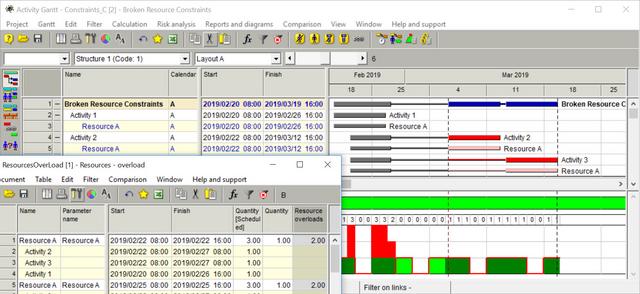
Possibly adding Workload field to this report would help to uncover a possible source of updating errors.
I wonder how P6 users would deal with unplanned partial workloads for work done as well as remaining.
Best Regards,
Rafael
- 0AIAnoon Iimos ·
Like the example given by
Like the example given by Zoltan (and insisting that he's always right). As you can see, Zoltan hangs the wall on electrical rough-ins. Dry walls or gypsum boards maybe are fire resistant, but in case you had screwed the walls directly on the electrical conduits and damaged the wiring inside, then I guess you need to call: HOUSTON WE GOT A PROBLEM! - 0VLVladimir Liberzon ·
If tighter logic (not FS but
If tighter logic (not FS but SS+Lag and FF+Lag) is acceptable then it should be used from the very beginning.
Activity dependencies shall reflect real life constraints and not the way we plan to do the work.
So Zoltan's example shows the case where out of sequence showed that the schedule shall be improved and out of sequence was caused by poor modelling of the real life constraints.
- 0AIAnoon Iimos ·
Vladimir, Exactly, but even
Vladimir, Exactly, but even SS+lag or FF+lag nor FS only (by Mike T. only), will never solve the problem of out of sequence. Activity relationships like human relationships is a mystery wherein you need to be flexible in order to capture the actual or real situation, so for me, it is wrong to insist on using "Retained Logic" only on schedules. Even human relationships need to divorce sometimes, and nowadays, people with the same sex are also getting married. Oh excuse me, nature is calling.... - 0AIAnoon Iimos ·
It is important to consider
It is important to consider that even prior to any update, a certain schedule may or is already "out-of-sequence" (as planned), without the planner or scheduler knowing it. As there is no quality control performed or quality assurance for scheduling. Hence, the so-called scheduler's head perhaps grew bigger than the ceiling, and thinking that the schedule will rule the site, and further aggravating the problem during the very first update, especially when insisting on using retained logic only. Further, it is always a fact that the best planners are the ones who actually do the works (corresponding to their respective disciplines or specialties or fortes). Therefore, should there be no inputs coming from this people during the preparation of the schedule, then expect that your schedule will never be followed on site (100%). Remember, the site has always Safety (safety first), Quality Control and Assurance considerations while your schedule has none or have nothing but only stupid logics. Oh I'm sorry Dr. PDG, we were posting at the same time. Yes I agree with you, but reality in most construction projects is not like that (at least from my own experience working on at least seven different countries for various construction projects for more than a dozen companies), but if you were able to see me personally, you might suggest that I'm only 29 years old. Anyway (kidding aside), preparation or development of an overall schedule alone is practically impossible to achieve, considering multi contractor environment or project, multi nationality, multi-culture etc. etc. But in the end, the GC or EPC Contractor must come up with something that must be called a "Master Schedule", no matter what, if it is out of sequence or whatever, otherwise, the GC will lose by default. And for me, this is always a fact. Best regards. - 0AIAnoon Iimos ·
Dr. PDG, LOL... I'm actually
Dr. PDG, LOL... I'm actually a civil engineer in my country, but I'm never a member of any professional and international organization, nor I got any certificate from PMI, AACEI or whatever. I had my first experience in construction when I was about 11 or 12 years old. And currently I'm unemployed, so this is a real life out of sequence LOL... Best,regards - 0AIAnoon Iimos ·
Rafael, for sure you knew
Rafael, for sure you knew that perhaps the top 4 or 5 biggest construction companies in the world today are all Chinese companies. Do you have any idea on what standards and or references for scheduling these companies were using? Should they got their very own way, then I guess these were never discussed here in PP. - 0AIAnoon Iimos ·
Rafael, Japanese contractors
Rafael, Japanese contractors just follow any standards set internationally, and they have this instinctive discipline that they even require all office workers (site office) to do physical exercise (stretching), first 10 minutes in the morning before starting any work. While I guess Chinese contractors are very different as they always have their own way of doing things (if not just usually copied from others). - 0AIAnoon Iimos ·
Dr. PDG, While I enjoy the
Dr. PDG, While I enjoy the videos (especially Mr. Bean), I think it will still be a long way to go. And I guess Rafael is just happy being a critic and behind him were laymen of over 3 billion people living in the planet. The 1,000 experts who made the compromise of course were entitled to their own opinion. As you know, even without that virtual equipment that you had linked, experience builders can always imagine the works by just closing their eyes. So what if you had that sophisticated equipment? Will it help to assign appropriate human or technical resources? And for sure it will always be a safety issue on site. Imagine having your workers covering their eyes with such equipment on site? Isn't it a chaos? Just allow me to be an annoying critic. Anoon - 0VLVladimir Liberzon ·
Dr. Paul,in your answer to
Dr. Paul,
in your answer to Rafael you discussed Spider Project and the reasons why it is not widely used.
For your information: Spider Project is used by most construction companies in Russia, in most large scale programs (like preparation of 2014 Winter Olympic Games) and was recognized as the best analytical tool for construction industry by Russsian Government Analytical Center. It is also used in all other industries (aerospace, railways, mining, shipbuilding, etc.).
It has customers in 35 other countries but they are few for many reasons:
1) At the conferences where I participated many people told me that they are impressed by Spider Project but their contracts require to use P6 and they do not have an opportunity to select the tool to be used. One person told me that his management explained him that since their company is involved in Government contracts they shall use only American software. So there are certain barriers that do not permit to select the software for construction management.
2) In Russia construction managers frequently asked me the same question:
Why managers in the West use tools that do not plan and manage volumes of work to be done, do not consider resource production rates, are not able to create and apply corporate norms, do not model project budget, use only one WBS, etc.
What shall I answer? The main reason was mentioned in your post: "I only use the CPM schedule as a guide and nothing more."
It does not matter what tool to use for creating CPM schedule that is not resource and cost loaded and used as a guide.
And you are right - most planners do not create project models that can be used for real management amd decision making, they create guides that may be used for contract management and for nothing else. The culture of planning is poor and declines if to compare with planning in early 90-s.
3) We never advertised Spider Project. The quality of the sofware is so high that it very soon became most popular in Russia by the word of mouth. It looks like this model (happy customers tell others) does not work abroad. It looks like software to be used is selected not by those who will actually work with selected tool.
_________________________________________________________________________
And about multiple WBS - as you know Spider Project permits to use multiple WBS since its launch in 1993. The number of different structures is not limited. This feature is always used by Spider customers for more that 25 years.
As for videos: nothing can replace proper planning. By proper planning I mean creating project model that takes into account all existing constraints, risks and uncertainties and finding the best possible schedule and required contingency reserves.
Best Regards,
VL
- 0ZPZoltan Palffy ·
I wonder why most of the
I wonder why most of the scheduling specifications prohibit the use of progress over ride ?. I guess they are all wrong and Anoon is correct go ahead and use it what could it hurt ? Then you can say HOUSTON WE GOT A PROBLEM! after you use progress over ride.
- 0AIAnoon Iimos ·
Zoltan, with all due respect,
Zoltan, with all due respect, I never said that I'm correct, but I'm always looking for the best or the most practical and reasonable solution to the subject issue and I hope you won't mind. And let me reiterate my stand that I'm with you to insist on using "retained logic only" for "Baseline Schedule" (AND/BUT ONLY FOR BASELINE SCHEDULE). However, for current, actual or working schedule, for me, it is better to be flexible. Which means that it must be necessary to reflect always the real or actual situation on your schedule, which you can never achieve if you are going to insist on using only retained logic. I for one believe that you are able to use P6 more than anybody here in PP (Honestly, I knew somebody much better than you, who was also an active member here before but I won't mention). As Dr. Paul said, that P6 and MSP users (sorry Spider, you were not included here), were only using around 10% of the functions of the software, but again, I for one believe that you were using much more than that (Perhaps around 11.5% for you). Anyway, if you insist on using retained logic only on all schedules, then it simply means that you never trusted the people on the grounds, or the ones who got their boots or safety shoes soiled all the time. And of course in return, they will never follow your schedule (in fact they never did). And therefore, you will be having out of sequence schedules all or every time. Best regards, Anoon Iimos (always available should you need assistance) - 0VLVladimir Liberzon ·
Hi Dr. Paul,Thank you for
Hi Dr. Paul,
Thank you for your reply.
It looks like we are discussing the same points but keeping in mind different ways of creating and managing project schedule. In our practice schedulers that sit somewhere outside is nonsense. The scheduling is the team work that involves not only scheduler but everybody who is responsible for something (including superintendents). It shall be accepted by everyone and people responsible for different parts of the schedule update them regularly.
An example of work organization on construction site in one Contractor company:
At the beginning of the shift superintendent of the 1st shift enters the numbers of resources (people and machines) that are available (if different than planned), levels the schedule and gets volumes of work that shall be done in his shift.
At the end of the shift he enters the volumes that were actually done and recalculates project schedule creating its next version.
Superintendent of the next shift does the same, etc.
Changing the work order (out of sequence) requires an approval from PM. If done on site without the permission the special report shall be sent to PM with the explanation why it was necessary.
If nothing wrong happened the schedule is analyzed for potential improvements and corrections weekly.
I described the real case that unfortunately is not common. It is also usual that the scheduler sits in the office and collects data from project participants and updates the schedule daily. If no objections or change requests were received the schedule is considered as accepted.
Owners usually update project schedules weekly.
You wrote about YOUR schedule that is not the same as the schedule created somewhere 100 km away. So you use different schedule but it is still project schedule, isn’t it? Then why do you need that original schedule that is useless?
It is common for contractors to manage three schedules in parallel: Contract schedule (do you mean this schedule as created by somebody that is far away?), Project Management Team schedule (that includes necessary contingency reserves) and Work schedule (that is optimistic). Superintendents gets and works with the Work schedule, the scheduler updates all of them.
As for VR and AR you wrote: Imagine the CPM schedule as not being a 2-dimensional piece of paper but a 3-dimensional video showing the workers exactly what work they are supposed to be doing as well as how the work is going to be done?
Yes, it is nice to show your schedule using VR and AR but first of all it shall be created and optimized. And this is mathematics that cannot be replaced by AR and VR.
Best Regards,
Vladimir
- 0AIAnoon Iimos ·
Intruder here..It's nice to
Intruder here..It's nice to read your sentiments about how you describe your own ideal ways of how construction scheduling is supposed to be done properly. Imagine if you two merge together in one project, I can only wonder if which principles or methods shall be followed? Perhaps if you just pay attention to most (if not all) questions posted here in PP (and mostly answered by Zoltan), you might think that what you have intellectually described as how scheduling is supposed to be done were not really happening in the real construction world. The big question is WHY??? FOR now I can only suggest that perhaps you can conduct a survey to as many contractors (only contractors all over the world) as you can and find out exactly how they prepare and implement their construction schedules? - 0VLVladimir Liberzon ·
Hi Anoon,I described what I
Hi Anoon,
I described what I have seen in the projects where I participated and which I attended as project management consultant.
You may consider this as an ideal way but it is not unusual in Russia. I found that abroad projects are managed different way - in particular it was strange to me that project scheduler creates project schedule himself without involvement of all project participants that is rare in Russia but common case in other countries. I have made many discoveries that did not anticipate. For example, few contractors abroad level project resources and plan and manage project expenses. Most of our customers work in Russia and their needs, their way of work, their problems are different.
If you think that this is an ideal way why not to follow it?
- 0AIAnoon Iimos ·
Hi Vladimir, Of course I
Hi Vladimir, Of course I wanted to follow it (if only I can, as a mere employee of a certain company for example). Realities abroad (or outside Russia), at least from my own experience, it is common to find a completely new team for a certain project, when you join a project for example, which can be first time for every one in the team (this is one and very important factor for me). Secondly, most decisions were made or shall come from another continent, in which you got no choice but just to follow. And the list goes on...And ultimately the poor scheduler on site will just do anything he can (even just copying a similar schedule) in order to come out with something to be called a schedule. Just look at most of the questions here in PP, and you might start to believe that what I'm telling are facts. - 0VLVladimir Liberzon ·
Anoon,I believe you and this
Anoon,
I believe you and this is sad. I have the same impression talking with the participants of different conferences. There are exceptions but few.
True scheduling works when company owners and top managers understand the value of good planning and what they can loose with poor planning and project control. When they see what money is saved by proper management project planners (we do not have separate term for schedulers) get full support and become powerful figures in project hierarchy. But in any case they are team members and scheduling is the team job. And good planning is easier to implement in small and medium companies where the owners and top managers try to save money. It is hard to implement changes in large companies where people are interested in their jobs but not so much in the results and need to follow methodology created by someone somewhere.
- 0AIAnoon Iimos ·
Vladimir, Of course these
Vladimir, Of course these companies have a high level scheduling in the first place to manage a certain contract, which perhaps using Top-Down approach, because most of contracts abroad were EPC. And before a poor scheduler on site knew anything, the construction has already started, while engineering is in progress or perhaps the GC is still looking for a specialist contractor. So "out of sequence" has occurred even before any detailed planning is done. What you and Dr. Paul have described were (for me) typical Bottom-Up planning for construction, given with complete engineering details. And I guess this never happen in most real construction world (at least from my own experience). Why? Just imagine a "project team" in which all the members were just mere contracted employees of a certain company, with a monthly salary or even a daily rate. Would you think the team would care about proper planning or delays when they cannot make any decision, but just make all kinds of reports?


Log in or join to reply
ProjectControls.com is free to join. Members can post questions, reply, vote and follow discussions.
Existing members: your original username and password still work. Forgot password?