
Local resources limit (for each project)
- Created
- 12
- 4
12 replies
Oldest first- 0ZPZoltan Palffy ·
no resource are global but
no resource are global but can be assigned to a specific project since they are global they can not have differnt limits for the resource itself.
What you can do is that AFTER you assign the activities you can change the Max Units/Time within the resource assigned too the activities.
Unfortunely you can't change these with a column fill down or a global change. The fastest way to do this would be to export the activities and resources to excel making sure to incluse the Max Units/Time in the export and change them in excel amd import them back into P6.
So to answer your question NO not at the resource level but YES at the activity level.
- 0OLOllie Lecm ·
Hi Zoltan,I did try your
Hi Zoltan,
I did try your method, however, the modified Max Units/Time value could not be imported back into P6 (it still shows old values).
And if there are more than 1 limit for a certain resource (due to error in input, for example), will P6 prefer the lower cap?
- 0RDRafael Davila ·
If everything else fails try
If everything else fails try the following:
Use pair of resources to limit allocations, assign the global resource and assign the local resource as shown in the following figure. If using P6 instead of resource quantity (ea) use effort (hrs.).
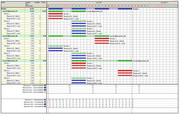
Good Luck.
- 0VLVladimir Liberzon ·
Yes Ollie,Rafael suggested
Yes Ollie,
Rafael suggested very elegant solution for P6.
You shall create local resources, add local resource assignments to global resource assignments (duplicate) and set limits to local resources.
This way you will get reports on both local and global resources and take into account local resource constraints.
In Spider Project global resources are not needed if local resources are included in the resource center.
- 0AFAlexandre Faulx-Briole ·
Hi Vladimir and Raphael,Local
Hi Vladimir and Raphael,
Local / Global resources do no exist in P6, only in Spider!
Therefore a "local" resource would only a ressource whose name contains the project name:
the "global" resource would be "Global - Alexandre", and the "local" one "Name of the project - Alexandre"; but P6 would dont understand much to this definition.
Alexandre
- 0VLVladimir Liberzon ·
Alexandre,local and global
Alexandre,
local and global are just terms.
Rafael suggested to duplicate resource assignments: to assign resource worker and another resource worker at certain location with the same workloads.
Then to set limits to local resources (total number of workers at some location) but not to "global" resources that work with the local resources together.
After resource leveling reports will show total number of workers and the number of all local workers required at any moment.
In Spider Project this is not necessary, Creating resource center "Workers" that includes all local workers the user may get any reports on all local resources and on resource center (overall number of workers).
- 0RDRafael Davila ·
Resource Pooling:One case is
Resource Pooling:
- One case is the one being discussed in this thread; a single pool (A), multiple projects (P1/P2/P3/…), each with their maximum availability (A/ P1/P2/P3/…).
Money on the bank is a case of pooling financial resources where availability can be determined by fixed dates or by activities not fixed in time.
https://www.slideshare.net/davilara11/financial-resources-leveling-111213157- Another case can be when resources are constrained on a periodic basis, similar to renewable resources, as well as for the total project duration, as with the consumable resources. An example is a total budget with an extra restriction of a maximum limit per period.
- Another case can be when multiple pools (A/B/C/…) each with their maximum availability provide resources to multiple projects (P1/P2/P3/…) and each project can only draw a particular resource from a particular set. This can be because of geographical proximity among the resource pools and the projects, you might wish to fly some resources while others must commute by car/train.
- Resources from different pools might have different production rates and when used the activity duration must be adjusted accordingly. In some cases where the difference in production rates is significant it might be desirable to substitute 1 high production rate resource with 2 lower production rate resources.
Spatial resources are an interesting case of resource pooling. Spatial resources are required by a group of activities, rather than a single activity as renewable resources. The spatial resource is occupied from the first moment an activity from the group starts until the finish of all activities from that group, can be dry docks in a ship yard or elevated slab forms that will remain in a building unless their use finishes on the building and only then will be available for use in another building. Do not ever try to resource level these as if regular renewable resources.
- Other.
- A combination of the above.
Each scenario has its particular solution for automatic resource leveling, manual leveling of resources upon every update can be a nightmare, manual leveling of a combination can be worst of nightmares.
Log in or join to reply
ProjectControls.com is free to join. Members can post questions, reply, vote and follow discussions.
Existing members: your original username and password still work. Forgot password?