Skip to content

Non cumulative Material Leveling

Daniel MoraisMember for 8 years 5 months
Created
62
9
0

Hi my friends,

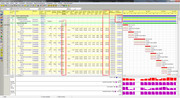
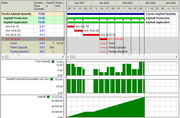
I would like to discuss some cases that I faced today. I'm leveling material from Spider but, I think that algorithm always considers that if you do not use the material in each period the same material goes to another period for use. The cumulative concept that's right for materials like bricks, gravel, cement and others but, for leveling composite materials like concrete and asphalt, that do not consider stock in real life the way is different. Spider have some key for not considering this? According picture bellow the leveling works very well because Spider consider that quantity not consumed (8units) in 11/30/21 will be cumulate and will consumed 12/01/21 together other, even resource Truck do not capacity (992units consumed) faced (1000units income (produced)). In systems where the material is produced and this product must be 100% used the stock concept is right? Have some way to consider this situation?

Follow file link,

https://we.tl/t-cK8c6F8ewd

Best Regards,

Daniel Morais


62 replies

Oldest first
  1. 0
    Daniel Morais ·

    We have one condiction that

    We have one condiction that asphalt plant have a productivity of 100ton/h and the asphalt finisher works in 700 ton/h, for compensate this gap we planned that we need arrive at least 14trucks for start the descharge, for avoid idle time of the finisher.

    So the formula is:

    F + ( A *14)

    where:

    F = Time to arrive

    A = Time to charge 

    14 = wait for 14 first trucks arrive to begin the descharge on the finisher.

    but, why 14? Answer: "field observation", we identified that 14 is a average number that best work the model based on the thickness of the asphalt layer (8cm). This is a constant, for this case of course, in another situation this formula can be different.

    @Rafael, this unit is right, is hour indeed.

    Kind Regards,

    Daniel

  2. 0
    Rafael Davila ·

    You say you need a minimim of

    You say you need a minimim of 14 trucks while for some segments your model say fewer than 14 are enough!

  3. 0
    Daniel Morais ·

    Yes, you are right

    Yes, you are right Rafael.

    Happened this little distortion but for global analysis this don't cause big troubles for us.

    Best Regards,

    Daniel

  4. 0
    Rafael Davila ·

    The constraint is on the

    1. The constraint is on the production rate, the lowest production rate along the production chain. In this case the production rate of the asphalt plant (100 tons/hr) is what drives the schedule.
    2. For Asphalt Application Km 30 to 40 activity my calculations yield a quantity of 3 trucks as follows:
    • We have a limit on the rate of placement of 100 tons/hr, this is a renewable resource.
    • We have a limit of 30 trucks.
    • A truck can be unloaded within 6 minutes 0r 0.10hr by the spreading machine; that is a rate of 250 tons/hour if a continuous operation. I do not see any reason not to spread the truckload at this rate if the machine has a capacity of 700 ton/hr and let the truck return as soon as possible.
    • Each truck with a capacity of 25 tons.
    • The truck cycle is:
    • = time to load/charge + travel to site/arrival time + unloading/discharge&spread  time + return travel time
    • = 0.17hr/cycle + 0.19hr/cycle + 0.10hr/cycle + 0.19hr/cycle = 0.65hr/cycle
    • If it takes the truck to make a cycle less than an hour then the number of cycles per hour he can make is more than one:
    • = 1hr / 0.65 hr/cycle = 1.54 cycles
    • Then within an hour a single truck can move:
    • = 25 X 1.54 tons/hr = 38.50 tons/hr
    • 2 or 3 trucks we have:
    • For 2 trucks = 2 x 38.50 tons/hr = 77 tons/hr
    • For 3 trucks = 3 x 38.50 tons/hr = 115.5 tons/hr
    • Because we have a delivery capacity a bit larger than the 100 ton/hr limit the plant can produce the trucks will be in a short wait at the plant, but this is usual.
    • Then we will have for 3 trucks = 3 x 33.33 = 100 tons/hr
    • Then we are better off if we use 3 trucks.
    • It does not make sense to slow down the cycle; just unload the truck as fast as possible in order for it to return as fast as possible. Of course between trucks arrival there will be a lag, just stop the spreading until next truck arrives, similar to what you do when changing trucks.

       3. I cannot understand why you use 12 trucks for this activity, the cost difference will be too much.

  5. 0
    Rafael Davila ·

    That is what I

    That is what I got:

    Image-001-Trucks-Asphalt-050

    https://www.mediafire.com/file/vreulo0b84hy0hx/Trucks_Asphalt.050_Worksheet.xlsx/file

    Image-002-Trucks-Asphalt-050

    https://www.mediafire.com/file/hnd4utjxfhtew2f/Trucks_Asphalt.050.sprj/file

    Truck-Resource-Hours-01 Your schedule use ~ 13,600 truck hours

    Truck-Resource-Hours-02 Can be done with 13 trucks using ~ 5,400 truck hours.

    Consumble resource leveling is what every scheduler do every day. It is a very simple model.

    It is easier to make the worksheet calculations using excel and then copy-paste the truck quantities and production rates. Discussing these calculations using excel with others is easier than using Spider as if a worksheet software, a worksheet software most others do not understand. 

    Best Regards, Rafael 

  6. 0
    Alexandros Kroustis ·

    Dear Daniel,For automatic

    Dear Daniel,

    For automatic quantity calculation the concept is the same.

    Based on your new assumptions, please click on the link below to download the programme with auto qty calculation:

    Click Here

    You can have productivity to get calculated directly in the productivity Field and not do the same work twice.

    As you can see I am using again a maximum number of 30 in my multi-resources. This could be also 100, it makes no difference.

    Also I have created formulas for auto calculation of asphalt consumption based on the calculated productivity, you need to be in Resource Gantt and have the trucks collapsed.

    Additionally I created a new User Field "Paver Productivity", which, based on your assumptions you will have approximately 125 Tons/h.

    In this version you can also identify the lost asphalt:


    Asphalt-04


    Here I must agree with Rafael, you need to check if it is actually worth having Paver productivity of 125Tons/h instead of 100Tons/h with so many additional trucks. 


    Kind Regards,

    Alexandros

  7. 0
    Rafael Davila ·

    Because of the inefficient

    Because of the inefficient use of resources your models at such high trucks assignments still require ~ 13,600 truck hours vs. 5,400 truck hours.

    The difference of 8,200 truck hours comes at a very high cost. I do not know your costs but in the US the truck rental would be about 95$(US)/hr.

    Dump Truck Rental | Arizona Trucking and Materials

    If you own the trucks my guestimate for truck ownership would be about half, say 50$/hr. To this you must add maintenance costs, driver and other miscellaneous costs such as labor burden.  If you own the equipment then the cost per operating hour would be close to 100$ per hour. This translates to a difference in cost of $820,000.00

    As if not enough you show a waste of asphalt material of ~ 2,360 tons. Although prices vary on average it would be $60/ton at the plant. This translates to a cost of $141,600.00

    2022 Asphalt Prices | Cost Per Ton, Yard, Square Foot, Pound (homeguide.com)

    If you schedule the plant to produce 100ton/hr and you install at the same rate there should be no waste. That you cannot place every drop of asphalt the min-plant produces is hard to believe.

    With such number of trucks and underutilization of placing resources your schedules are feasible but the additional cost of $(US)961,600 is not justified. You must be in the opulence!

    The goal is not the showcasing scheduling capacity of Spider Project, such simple schedule can be done with most other software. The issue is about creating a good an efficient model.

    Best Regards, Rafael. 

  8. 0
    Daniel Morais ·

    Hi friends,Yours

    Hi friends,

    Yours argumentations is everyhing right, one exception is because the work on pavaing don't beginning on exactly moment after unload on field, that is if this happen, the finisher will start and stop, start and stop so (because her consume 700t/h much more that the capacity of the asphalt plant so, every system must to be calculated by the bottleneck), we must to be one minimum quantity of the asphalt for her start and do not stop until finish of the shift. 

    @Rafael between your model and my model the only difference is because you used time to descharge = 0,10h and I used another number, i will revise it, but really it dot not is 0,10h, really of the field is different, me too agree that I can change the formula, but definitely is don't 0,10h...

    For another information, our trucks are do not subcontractors, he are own, he are much cheaper than USA, but obviously this don't justificate that we can make bad use they.

    @Alexandros thanks by your formula, I will increase on the model. 

    Kind Regards,

    Daniel


  9. 0
    Rafael Davila ·

    Parkinson’s Law is the idea

    Parkinson’s Law is the idea that work expands to fill the time allotted for its completion. This may mean you take longer than necessary to complete a task or you procrastinate and complete the task right before the due date.

    By giving so much time to unload probably they take it easy, the same go with the truckers. Eventually they will get it and slow down. On the other hand too tight targets are not a good idea.

  10. 0
    Daniel Morais ·

    Yes, I have a big trouble

    Yes, I have a big trouble here too, the culture of the managers of the production is bad, I spend many energy for do anything of the planning for help they, but sometimes I have no success... This our discussion is a good example, I have already explained that we could decrease the amount of the trucks, but they don't decrease, because they want to work with more...like I said, culture!!! In this case, bad culture!!!

    Kind Regards,

    Daniel

  11. 0
    Rafael Davila ·

    After you give a candy to a

    After you give a candy to a kid it is difficult to take it away.

  12. 0
    Daniel Morais ·

    Exactly, this type of the

    Exactly, this type of the thing only works when done by top down, but it wasn’t.

    Regards,

    Daniel

Log in or join to reply

ProjectControls.com is free to join. Members can post questions, reply, vote and follow discussions.

Existing members: your original username and password still work. Forgot password?