
P6 Calendar changes during the project
- Created
- 66
- 11
Hello
I have a couple of questions regarding the calendar within P6.
1) If you are working on a project which starts with only a day shift then so far into the project a night shift is introduced, do you need to reflect this night shift work in the calendar?
2) What difference does it make to the schedule if you change the calendar apart from changing the activity durations?
Thank you in advance
66 replies
Oldest first- 0RDRafael Davila ·
Be reminded that usually work
Be reminded that usually work on different shifts is scheduled at different hours per day, using different crew with different production rates. I do not know how P6 deals with such scenarios but the need to model team assignments and independent assignments is essential to model shifts on same activity.
- 0ZPZoltan Palffy ·
1) If you are working on a
1) If you are working on a project which starts with only a day shift then so far into the project a night shift is introduced, do you need to reflect this night shift work in the calendar?
not necessararily it depends if you are tacking and manloading the schedule. A working day is still a day no matter if it is 1 or 4 shifts it how you want to represent it.
2) What difference does it make to the schedule if you change the calendar apart from changing the activity durations?
it depends on wht changes you make to the calendar. For example if you add holidays that reduces the available number of working days for that particualr month. Thus reducing the available overall time frame for the project.
1. you may create a seasonal calendar maybe you can only plant during the fall and spring. Then you assign planting activities to this specific calendar which means that the planting activities can only happen in the spring and fall window.
2. Maybe your job shuts down during the winter. Then you would block out the winter months in the calendar. That means that now work will be shown during the winter months.
3. Maybe you project closes from Christmas until after the new years. That means no work will be shown during this period.
bottom line it all effects the calacualtion of total float.
- 0AIAnoon Iimos ·
Question no. 1: Yes of course
Question no. 1: Yes of course as you introduce new resources, correspondingly, adjustments to the schedule and or calendars would be necessary. You might consider breaking up some activities while shortening durations and accommodating several shifts. Question no. 2: Additional workforce or resources would mean additional cost. However, Time also means cost. So I guess it is just a matter of balance between time and cost. Which one is economical without sacrificing quality and the committed completion of works. - 0RDRafael Davila ·
Breaking up activities does
Breaking up activities does not make sense when different teams work on the same activity. Splitting the activity is a very poor work around when different shifts work on same activity.
When you split a resource loaded activity because other activities might be competing for the same resouces there is a risk each sub-activity will be scheduled non-contiguous by the resource leveling engine. If not enough re-distributing the volume of work among the sub-activities and calculating their adjusted durations every time these are delayed as schedule moves will be a nightmare.
Learn to schedule shifts within same activity using your software, no big deal, should be easy.
- 0AIAnoon Iimos ·
For real life example:
For real life example: Firstly, you got a simple activity called Concrete Foundation. One activity, resource loaded with several crew and shifts for example. This is a challenge to Rafael and perhaps Vladimir (though I got nothing to bet). Please show us how you schedule it correctly using automatic resource leveling. And please explain further on how you have considered components such as the following: Earthworks, Formworks, Rebars, and Concrete. Simple as it is and may make people's belief changed in an instant perhaps. - 0AIAnoon Iimos ·
There is no problem Vladimir.
There is no problem Vladimir. I'm just quoting Rafael who said: It doesn't make sense to break up an activity involving multiple crews and or shifts as it may result to erroneous automatic resource leveling. As I believe Rafael always have a better way (if not the best) to do scheduling. So if you may kindly please show planning planet community if how you actually do it in real construction activity like for example: Concrete Foundation. Without breaking up or granulating the said activity, please show us how you assign multiple crew and shifts and arrive to a realistic schedule (in your simplest and quickest way and of course, accurately). Many thanks in advance. - 0AIAnoon Iimos ·
Ok, maybe not fair enough,
Ok, maybe not fair enough, but that's real life anyway :). In my opinion what Rafael is saying "Maybe" or only applicable to single unit of scope, but not for activities involving multiple units of scope like concreting for example. Please confirm Rafael, come on! Be fair. - 0RDRafael Davila ·
Anoon,Same as Vladimir I
Anoon,
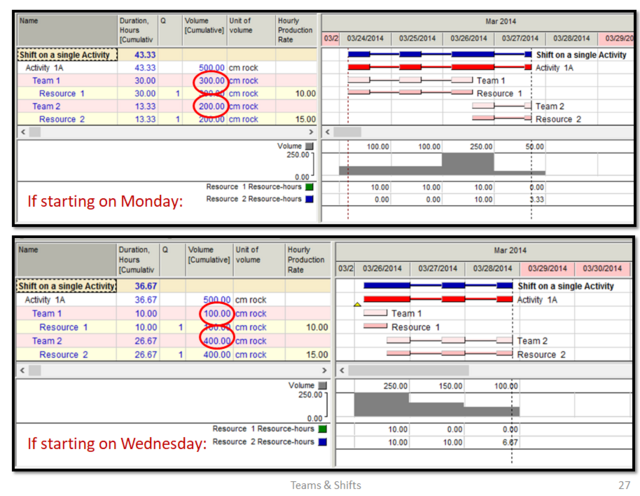
Same as Vladimir I cannot follow your request but It is enough to show the one activity sample schedule I already provided. It is a no brainer, if activity start moves so do shifts start, because shifts have different production rates the activity duration changes. If you split the model into two activities in no way the model will make the adjustments as it will not know what volume of work is to be performed by each individual activity. If the volume of work is kept within a single activity the volume of work remains 500cm. Please turn on the volume, the music is on the house, expand to full screen for a better view.
Please take a look at my Fri, 2018-11-02 18:43 post for a static view.
If activity starts on Monday:
Monday =>> Resource 1 will produce 100 cm
Tuesday =>> Resource 1 will produce 100 cm
Wednesday =>> Resource 1 will produce 100 cm
Wednesday =>> Resource 2 will produce 150 cm
Thursday =>> Resource 2 will produce 50 cm in about 3 hours
Activity will take 3 days 3 hours.If activity starts on Wednesday :
Wednesday =>> Resource 1 will produce 100 cm
Wednesday =>> Resource 2 will produce 150 cm
Thursday =>> Resource 2 will produce 150 cm
Friday =>> Resource 2 will produce 100 cm in 6.67 hours
Activity will take 2 days 6.67 hours.After all work is done no need for resources to hang around doing nothing, they will be realeased and become available to do work on other activities.
Best Regards,
Rafael
- 0RDRafael Davila ·
The example I provided is for
The example I provided is for a single unit of work that drives the activity duration. If there is another unit of work that drives activity duration in such case their volumes of work are not incidental but independent, if two independent volumes of work it makes two activities and merging the two into a single activity will be as wrong as splitting the activity in my example.
- 0VLVladimir Liberzon ·
Anoon,on the screen below one
Anoon,
on the screen below one activity that is done in three shifts.
On the 1st day only shift 1 is available, on the day 2 shifts 1 and 2 are available, on the day 3 all shifts are available.
Activity has 100 units volume. Productivity of the first shift is 1 unit per hour, second shift has 0.9 units/hour and 3rd shift 0.8 units/hour productivity. They work until the whole activity volume will be done.
Let's assume that they spend some material with the name of concrete 1 unit per volume unit.
Diagrams below Gantt Chart show material consumption per hour and cumulative.
I don't know if understood you question properly. And I agree with Rafael that activities with different volume units (and assigned resources) shall be shown and calculated separately in the detailed schedule.

- 0RDRafael Davila ·
The following video showcases
The following video showcases how artificial splitting of activities can yield undesired results.
- If Activity 1 is split but its execution shall be contiguous depending on resource demand and availability resource leveling might or might not schedule undesired non-contiguous execution of sub-activities. If you add resources A then it might schedule contiguous execution of sub-activities.
- It might be that initially sub-activities are scheduled contiguous but if delayed they might be scheduled non-contiguous. The might or might-not must be eliminated in order to get a good model, you eliminate it by avoiding artificial splits.
Artificial splitting of activities is not a good practice, unfortunately there are many who promote the contrary by requiring all activities to meet some maximum arbitrary duration, the workaround being artificial splitting.
- 0AIAnoon Iimos ·
Fair enough for me. Thanks
Fair enough for me. Thanks Gentlemen. However, I for one believe that even a single unit of scope may need to be separated depending on crew, equipment, price and sequence necessary. For example: Rebars or steel reinforcement maybe measured in terms of kilograms (kg), and Formworks maybe measured in terms of square meters (m2) and Concrete is in cubic meters (m3), and they all boils down to cubic meters or volume of concrete. What I'm trying to say is that: even rebars and form works have their own unique unit of measures and perhaps prices, they may need to be separated within themselves. Why? Again, for example: There maybe completely separate activities involving exactly the same material, and may as well utilized completely different equipment. Another Example: Fabrication (maybe in shop or on site), and Installation of course on site. And you don't only bite these materials but of course you use some kind of equipment in order to utilize them and serve its purpose. So who's saying that automatic resource leveling is a piece of cake? Come on, please show us some realistic thing and not just an imaginary activity (which maybe manipulated). - 0RDRafael Davila ·
Once you get a good model
Once you get a good model automatic resource leveling comes at a single click, a piece of cake. Creating models for different shifts on same activity is usually a piece of cake if using Spider Project. I expect it to be the same if using P6. Needless to say that more complex scenario can be difficult but my sample scenario is easy, it is about a single activity, cannot be any easier.
As I see it, it is just a matter of learning how to use the software.
If not that easy, that is fine, what is not acceptable is that you cannot model different shifts on same activity and get reliable results without using manual adjustments. Artificial splitting of activities is wrong, no matter the purpose.
- 0AIAnoon Iimos ·
Apologies to A. T. who
Apologies to A. T. who started this thread, I just hope you enjoy the discussions (I like Rafael's background music). Vladimir said: "Activities with different volume units and assigned resources shall be shown and calculated separately in the detailed schedule". While Rafael said: "Once you got a good model, automatic resource leveling comes at a single click, a piece of cake". Well, I cannot agree more, but I guess P6 can always do the same (as exactly based from your own statements that I quoted).
So perhaps it again boils down to how detailed a schedule need to be to arrive to the best model where you can do resource leveling at a single click. In other words, if your schedule (or activities) is not discretely measurable, then it is not a good model, therefore when applied with automatic resource leveling, may always come out with eroneous results.
The thing is: When you are working with a multi-disciplined, multi-contractor and or multi- specialty subs, then how can you create a good modeled overall schedule?
From real life experience for example: In High Rise Building construction, they normally use 1st Fix, 2nd Fix, Final Fix as activities for Electro-Mechanical works, so of course these are not applicable, but these are what management wanted to see.
In Oil & Gas plants, you may use Inch-Dia or Inch-Meter for piping works which a bit measurable (but very confusing sometimes), however, fabrication of piping spools, vessels etc. maybe done in another continent so how can a poor Scheduler on site create a good model for a schedule?
In shutdowns / Turnarounds, how do you measure activities like degassing, pigging, putting spirits or detergent, gaskets, blindings etc. etc. etc. and apply automatic resource leveling?
- 0RDRafael Davila ·
Installation of Materials are
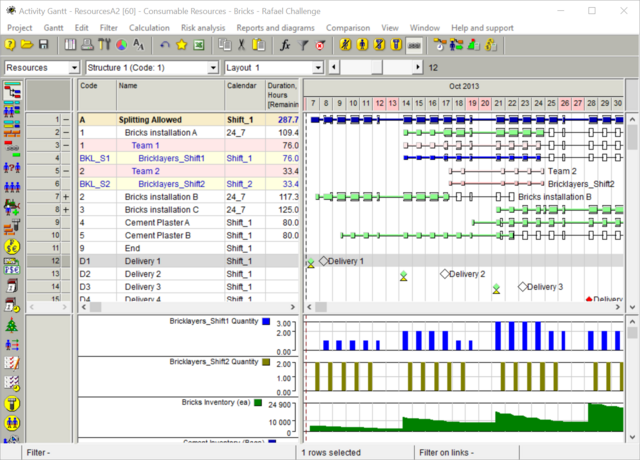
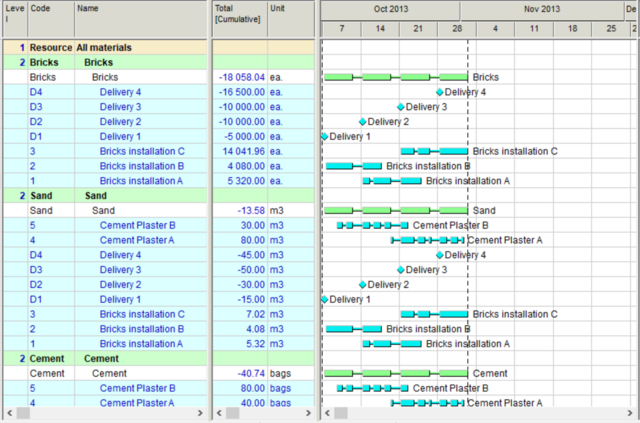
Installation of Materials are consumable resources that represent volume of work, if used on same activity they represent different volumes of work on same activity. Same as regular renewable resources they must be leveled, if not available activity execution stops. Because their installation is a function of brick installation it is enough to model Bricks volume of work for activity, you shall be able to view materials installation/consumption within a view or a report. Now we are talking about models a tad less easy. A detailed discussion of this belongs to different topic.
In this scenario materials are to be delivered once a week by barge to a remote island.
- 0VLVladimir Liberzon ·
Hi Anoon,we suggest to define
Hi Anoon,
we suggest to define project activities basing on the following rules:
- an activity has certain measure of volume,
- an activity is performed by certain crew,
- assigned resources have certain productivities,
- an activity requires certain materials and if their consumption is continuous then the values per volume unit are the same for all parts of an activity
- the same about the costs
- activity duration does not exceed 2 weeks (preferably one week). Exceptions shall be rare and for activities which volumes were defined.
It is not possible to show real project models consisting of thousands of activities in the forum message. So we discuss approaches, methods, capabilities. If you suspect any manipulations just download Spider Project Demo from http://www.spiderproject.com/index.php/spiderproject/spiderdemo and try everything yourself. Any questions are welcomed in Spider Project forum.
- 0VLVladimir Liberzon ·
Anoon, you wrote: I guess P6
Anoon, you wrote: I guess P6 can always do the same.
Not always:
P6 does not simulate the work in several shifts,
P6 does not work with work volumes and resource productivity,
P6 does not take into account material, space and cost constraints,
P6 does not allow for continuous activities,
P6 does not simulate variable resource assignments,
P6 does not have skill scheduling,
P6 calculates poor resource constrained schedules and a lot more.
- 0AIAnoon Iimos ·
If I remember correctly, I
If I remember correctly, I guess we had the same discussions around a decade ago, that's why I requested the modeling of a simple activity called: Concrete Foundation. If it does not need to be broken down into measureable and discrete activities (and applied with automatic resource leveling) and come out with accurate results using Spider Project, then that's what I wanted to see. However, you both answered otherwise, and ideal principles which I cannot agree more (so it seems sound the same sales pitch to me, Sorry).
Honestly, I haven't used P6 for almost a decade as well, but based from the principles that you have clearly stated, I believe that you can do good schedule model and apply automatic resource leveling using P6 and come out with a result perhaps have no difference than what a Spider can do. That's my opinion.
If were to model the said activity (Concrete Foundation) using P6, I would even consider fabrication works (separately), and even striking of formworks or even quality inspection works. And for sure you knew that concrete pouring itself (depending on the volume) may only take a couple of hours or so.
I only want to see (and perhaps many other members of this site as well) how do you exactly model the mentioned activity (concrete foundation) using Spider Project. Please don't show other examples that you've shown perhaps several times already and I guess no one bought (but I loved the background music anyway). Please?
Thank you.
- 0VLVladimir Liberzon ·
Anoon,I did not understand
Anoon,
I did not understand why an approach that suggests to represent Concrete Foundation not as one activity but as several activities with different volume units, crews, productivity may be considered as the sales pitch.
Of course P6 can be used for modeling and automatic resource leveling but with certain restrictions. The model will not be the same as Spider model. In Spider Project we will enter volumes of work in physical units (tons, sq meters, cubic meters) and activity duration will be calculated taking into account assigned resource productivity, and Spider Project will delay concreting to the beginning of the next day if it will not be able to finish the same day with the start. Spider Project will also model work in several shifts.
I suggested before and repeat my proposal: describe your project in details (or show its schedule created in any tool).
What is needed: a set of activities with volumes, duration (or even better - productivity of assigned resources), assigned crews, dependencies between activities. If you want to model the work in several shifts specify the crews and productivities in each shift. I will create and show the schedule based on your data. Unfortunately it will be too simple for resource leveling
An example that I have shown in this thread was created today as an answer to your request that I did not fully understand. So your statement "Please don't show other examples that you've shown perhaps several times already and I guess no one bought" is not correct.
- 0RDRafael Davila ·
If you want to see how others
If you want to see how others would schedule Concrete Footings I suggest you create a separate discussion, if you want to make sure Spider Project users get into it then create the discussion under Spider Forum. In this way we will avoid hijacking the discussion away from A T, the creator of this discussion.
I will keep posting examples in this discussion related to the main topic initiated by A T - calendar changes and shift models.
I will avoid as much as possible not posting here examples that are not related to the main topic initiated by A T. Usually Concrete Foundations is an activity that can be scheduled without the need to use more than one shift, partial workloads on some assignments will do it. At times a single activity will render better model, at simes several activities are needed to get a better model, this we can discuss under separate topic.
- 0AIAnoon Iimos ·
I'm just wondering why P6
I'm just wondering why P6 users still keep on silent even when this two Spider Stalwarts keep on mauling a poor and innocent scheduler who haven't even used P6 for almost a decade? I guess there are three reasons: 1. P6 is really flawed. 2. Or the reasoning of the Two Gentlemen-Stalwarts were not worth a peek (ouch!), and 3. P6 users have never get matured and educated, thus, just making a very expensive software act as just a drafting tool drawing schedules. No wonder why most companies (even top tiers) just switch to MS Project (MSP don't understand how to update and maintain schedules). Or is it that, the importance of Planning and Scheduling is still not really understood within the business and industry? - 0RDRaymund de Laza ·
I am using the P6 for several
I am using the P6 for several years and its quite performing excellent for the purpose.
The main subject what Users want to generate from P6 are the following:
1. Planned Value
2. Cash Flow
3. Earned Value
4. SPIResources such as Materials, Labor and Equipment are also loaded but users are less interested on what output they may gain apart from when will the Resources are needed at site.
The examples of Rafael and Vlad are excellent in terms of Manufacturing Industry where Hours or Minutes duration are used.
P6 can also functional with that examples. Frankly, in Construction, their examples will not work out.Regards,
- 0VLVladimir Liberzon ·
Raymund,maybe we have
Raymund,
maybe we have different experience.
We plan construction works as people do considering all factors that people consider when schedule their work.
In particular:
we use activity volumes in physical units and calculate activity duration basing on assigned resource productivities.
we simulate work in several shifts for getting realistic plans and right data on the numbers of workers required on construction site,
we remember that continuous jobs like concreting shall start and finish on the same day,
we plan construction jobs defining minimal and maximal quantities of assigned resources to avoid unnecessary delays,
we assign resource quantities and workloads instead of man-hours like people do,
we take into into account that different resources may have the same skills and may replace one another on certain assignments though with different productivity,
we try to create the shortest feasible schedule taking into account resource, cost, space and supply constraints.
What of the above is good for manufacturing but useless in construction?
And please show us how "P6 can also functional with that examples."
- 0AIAnoon Iimos ·
Raymund, Please visit the
Raymund, Please visit the "Hijacked Discussions by Rafael Davila". You can post your sample project there (I guess with Rafael's permission), I mean using P6, resource loaded, and automatically leveled. You can use my data for construction of 1 bored pile (already posted there). Please prove to Vladimir and Rafael that P6 is very much more superior than Spider Project. I can't do it myself as I don't have the software and I'm not really familiar with P6, I only do manual scheduling, but if you have any questions, please don't hesitate to ask. - 0RDRaymund de Laza ·
Sir Vlad,My response are as
Sir Vlad,
My response are as follows:
- we use activity volumes in physical units and calculate activity duration basing on assigned resource productivities.
P6 has Budgeted Units (Quantity of Work) and Calculate either the Duration or Productivity rate upon setting up the Duration Types.
- we simulate work in several shifts for getting realistic plans and right data on the numbers of workers required on construction site,
P6 can generate number of Workers from the inputs of Man-Hours or Man-days per Duration.
- we remember that continuous jobs like concreting shall start and finish on the same day,
Concreting may take more than a day and continuously until the element is completed; for example such as Raft foundation of a high rise and slip forming casting of a Silo.
- we plan construction jobs defining minimal and maximal quantities of assigned resources to avoid unnecessary delays,
This is a Planning Skill of a Technical Planner and Scheduler. But not the IT Planning Tool user.
- we assign resource quantities and workloads instead of man-hours like people do,
In my experience, I assign Quantity of Works and Unit Prices to generate the Planned Values. This is where the EV is obtained.
- we take into into account that different resources may have the same skills and may replace one another on certain assignments though with different productivity,
In my experience, I assign a Crew for a certain Activity. The Crew may consist of Foreman, Skilled and Unskilled. The productivity of the crew and number of worker per crew is obtained from experience.
- we try to create the shortest feasible schedule taking into account resource, cost, space and supply constraints.
This is a Planning Skill of a Technical Planner and Scheduler. But not the IT Planning Tool user.
The above is Good for Manufacturing and Construction.
I am actually referring to a Resource (Material, Labor & Equipment) that will be assigned to different task in which for example the Foreman shall man the Steel Fixing then go to other area to man the Formwork then go to the office to verify the drawing then go to the other structures with ongoing casting of concrete. These cannot be modeled in a construction schedule.As I explained above, P6 can also function as what you say it can be done in Spider.
- 0VLVladimir Liberzon ·
Anoon,one bored pile is not
Anoon,
one bored pile is not an example that may show software leveling capabilities.
Leveling example requires activity competition for constrained resources and so it shall include activities that may be done in parallel but require the same machines or specialists.
So please suggest something else. In Spider Project Demo that may be downloaded from http://www.spiderproject.com/index.php/spiderproject/spiderdemo there is sample schedule of 1km road construction. Though this project does not contain work in several shifts it may be used as an example of detailed planning that includes resource leveling.
It would be interesting to see the same model in P6 or MSP.
- 0RDRafael Davila ·
Raymund,In order to follow
Raymund,
In order to follow how you relate partial workloads and resource quantity please show how you would handle the sample 3 activities scenario shown in slide 6 of the following presentation using generic resources as well as named resources.
- If you schedule the work to happen within same day the software shall warn you of resource quantity overload, otherwise it is unreliable. What it is showing?
- If you use P6 automatic resource leveling will it get reliable results?
Best Regards,
Rafael
- 0VLVladimir Liberzon ·
Sir Raymund,my questions and
Sir Raymund,
my questions and answers to your answers are below.
Do you measure budgeted units in meters, tons, cubic meters, etc.?
Generating the number of workers from man-hours is not correct and besides I wrote about simulating work in several shifts
Concreting may last several days if the work calendar is continuous. I meant other case.
Planning Skills of a Technical Planner and Scheduler shall be used in creating realistic project schedule. The job shall start when minimal requirements are met and if additional resources will become available they shall join and accelerate activity execution. If IT tool does not plan like people do it will not be used for practical planning.
Resource quantities (numbers of people and machines) are not the same as work quantities (volumes)
Productivity of the crew depends on the number and productivity of crew resources.
Planning Skill of a Technical Planner and Scheduler is required for creating adequate project model that properly reflects project technology and constraints. IT tools are used for calculating the best project schedule that meets all project constraints. If people can do it better than the tool then the tool is poor or it is not the scheduling tool.
Foremen are usually assigned to the hammock activities. It is modeled.
- 0AIAnoon Iimos ·
Vladimir, Of course it is, a
Vladimir, Of course it is, a bored pile may look so simple, but in fact it is not. Please give it a try and we shall see. You might consider some scenario of cave in (hole), so you may need to apply some solutions and for concrete pouring, you need to sequence it properly, otherwise, you may end up rejecting the concrete mixture, or worst, may condemn the whole structure and start all over again. And of course it has steel reinforcements, and provision for testing (necessary - otherwise, you will never know the integrity of the pile). That's why I want to see, how you practically model it and schedule using Spider Project (and P6 for Raymund). I won't give further details until you asked for it (like what a Planner practically do, as Mike said, you cannot plan it, if you cannot build it). I just accepted your challenge, remember? No thanks for now. - 0AIAnoon Iimos ·
Vladimir, I'm beginning to
Vladimir, I'm beginning to suspect that Spider can only do what may be P6 can do the same or even much better. If you think you cannot model automatic resource leveling in one bored pile, then you can make 2 bored piles at the same time. It's just a sample anyway. We shall see if how accurate Spider schedules real construction projects. BTW, sorry, I'm just using a very small screen mobile, so its difficult for me to respond quickly. And of course I don't have any scheduling software of my own so I cannot show you any sample. - 0VLVladimir Liberzon ·
Anoon,I can accept the
Anoon,
I can accept the schedule created in any tool including Excel and will show how it looks in Spider Project.
If you are interested please move this discussion to Spider Project forum and describe your project in details:
1) The list of activities
2) Activity dependencies
3) Activity volumes of work in physical units and their durations
4) Assigned resources (people, machines) and their calendars
5) Required materials (by activities and resources) with their quantities (total or per volume or time unit)
6) Resource and material costs (if you want budgeting)
7) Project constraints
You may also suggest to model uncertainties in volume, duration, productivity, costs (or anything else) suggesting minimal, expected and maximal values and risk events that may happen with expected probabilities. For risk events describe the impact - what they will change in your project if happened.
I will be glad to enter your information in Spider Project and show anything you may require in Spider Project forum.
- 0AIAnoon Iimos ·
Vladimir, That's exactly the
Vladimir, That's exactly the point I wanted to make. Any software can become useless if there's no data to feed in whether correct or not. If the operator (the so-called Planner or Scheduler), have no idea how to build what he/she is supposed to schedule, then what do you expect? Even if you give them the very best software ever created (if any), you can never expect that they will give you the best output as well. Now, if Spider and P6 may perhaps use the same engine (or algorithm), and you input exactly the same data, then what would be the difference in their own outputs? I guess nothing, unless you prove otherwise. - 0VLVladimir Liberzon ·
Anoon,this became pointless
Anoon,
this became pointless discussion. Of course any software is management tool and makes calculations basing on entered data.
You wrote that you want to see how Spider will model your project but do not want 1) start this discussion in Spider Project forum, 2) describe your project in details to avoid different understanding of what do you want to model.
For your information: Spider Project and P6 use different algorithms and use different approaches to modeling projects. They have also different modeling capabilities that was already mentioned in this discussion. And they may create different schedules for the same project as was discussed here http://www.planningplanet.com/forums/planning-scheduling-programming-discussion/574396/comparison-resource-levelling-algorithms-di
If you are interested in learning how Spider Project models some projects or situations that you may suggest, make the proposals in Spider Project forum. It does not make sense to continue here.
- 0AIAnoon Iimos ·
Vladimir, Yes, let's stop it
Vladimir, Yes, let's stop it here. I hope AT got his answers already. One thing maybe worth to remember, when you're dealing with a dynamic schedule, once you made additions, subtractions and or variations to it, then you may need to adjust anything associated with it as well, otherwise the results may come out not as what you have desired. BTW Vladimir, If I give you all the details you wanted for a schedule, then that would make me the real Planner, and you as the Data Encoder only (and I don't think you'll like it:). This I guess is what's really happening in the real world, especially for complex projects. - 0RDRaymund de Laza ·
Sir Vlad,Do you measure
Sir Vlad,
Do you measure budgeted units in meters, tons, cubic meters, etc.? ... Yes Budgeted Units are measured in Tons, M³, m², LM etc.,
Sir Rafael,
Let me clarify the terms Workload and Quantity in your Sample. As I understand Resource A (2#s) is working for only 4.8 hrs out of the 8 hrs/day and Resource B (3#s) is working full time of 8 hrs out of the 8 hrs/day.
Is this correct?
- 0VLVladimir Liberzon ·
Sir Raymund,thank you for
Sir Raymund,
thank you for your answer.
If budgeted units are set as physical units then assigned resource productivity shall be set as budgeted units per hour, isn't it?
I would like to see the P6 scenario where activity budgeted units are 100 m3 and the job is done by two resources with productivities 2m3/hour and 3m3/hour. Very simple case.
About your question to Rafael:
Workload means the percent of work time the resource is busy on certain activity.
So in your example both resources (A and B) have 8 hours work day. One (B) if fully loaded on the activity and another spend on activity only 60% of work time (4.8 hours per day) and so have 3.2 hours of day work time that may be used for something else (for example on another activity that requires 3.2 hours per day of his work time).
So resource A availability is 16 hours/day and it is assigned for 4.8 hours/day on each of three activities in Rafael's example.
- 0VLVladimir Liberzon ·
Sir Raymund,if activity
Sir Raymund,
if activity budgeted units are 100 pieces, and assigned resources have productivity 5 pieces per hour (2 + 3) then activity duration shall be 20 hours, isn't it? P6 shall calculate activity duration basing on these data. But it is different in the screen that you published. Why?
Besides, volume of work is activity property. You showed budgeted units assigned to resources (100 to each). Why?
- 0AIAnoon Iimos ·
Gentlemen/Sirs (Madams-if
Gentlemen/Sirs (Madams-if any), Sorry but why waste your precious times on an imaginary sample with imaginary activities and or resources when you can do a real one? (I had suggested). Rafael has been doing this for years and his sample projects were never finished (what a poor scheduling). Of course Resource-dependencies can be completely different from logic-driven activities plus considering calendar definitions for activities and resources. If they are all not consistent, then what do you expect? Oh come on! Will you show a real one please?! - 0RDRafael Davila ·
Raymund,Please use named
Raymund,
Please use named resources without using roles as most people do and show the results.
If there were no difference betewwn roles and generic resources then one or the other is not necessary.
If it fails to show same duration then there is an issue. If using P6 roles it shows different sachedule as if using named resource without using roles there is another issue.
As far as I recall P6 role functionality is not the same as true skill replacement. It cannot even do the basic automatica substitution of one resource for another, it cannot do automatic replacement of a single resource with a multi-resource consisting of two resources as it happens when a single planning engineer can be replaced by two rookies working at a different production rate.
Please see Page 29 of the following reference.
https://www.ronwinterconsulting.com/Reviewing_Resource_Leveled_Schedules.pdf
- The process does not allow P6 to automatically substitute one resource for another.
- P6 cannot automatically convert one type of resource into another (say two Journeymen for one Expert.)
Best Regards,
Rafael
- 0VLVladimir Liberzon ·
Anoon,It looks like you don't
Anoon,
It looks like you don't know what are the real schedules usually consisting of thousands activities.
In other case you would not suggest Rafael to show them in the forum posts.
It looks like you do not want or cannot describe the project for starting discussions on Spider Project capabilities.
Please create new topic in the corresponding forum if you want to discuss something special.
It does not look nice to discuss problems that are not interesting to the topic author and waste his precious time.
Log in or join to reply
ProjectControls.com is free to join. Members can post questions, reply, vote and follow discussions.
Existing members: your original username and password still work. Forgot password?