
Resource cost rounding
- Created
- 65
- 11
Hello Vladimir,
Materials in Spider have an option called Discrete Consumtion which rounds up the consumtion of the material (granted the Backload consuption is set to No).
So here is my question, is there a way to do this with resources?
Example:
Backhoe is paied by the day even if it works for 2 hours or for 8. I would like to know if there is a way to take this into account when calculating costs.
Best regards,
Bogdan
65 replies
Oldest first- 0VLVladimir Liberzon ·
We use hammock activity that
We use hammock activity that starts with the first usage of backhoe and finishes with the last.
This hammock has special calendar with one hour per day work time. This one hour finishes at the first minute of backhoe work day. The cost of using backhoe is assigned to this hammock as the cost of backhoe day per hour.
The cost may be assigned directly or as dummy resource backhoe cost.
- 0BLBogdan Leonte ·
Understood,however this
Understood,
however this method may complicate model a lot if you have 10-20 contruction machines which have this type of cost. Couldn't there be an option for assigments "Round to full day" wich will round the costs to a full day according to the resource calendar, this way you will be able to take into costs for days in which the resource cannot work a full day due to weather conditions, for example.
Also what happens if you use the resource from day 1 to 5, then the resource leaves and comes back on day 60 and works from days 60 to 75.
- 0BLBogdan Leonte ·
I will use the method you
I will use the method you described, with hammocks.
The only solution I have to your solution is to create a macros in excel (use the export to CSV then import) which will create hammocks for resources if the time gap between their usage is less than X days (specified by the user) but I don't think it will prove very productive.
Thank you for the solution.
- 0BLBogdan Leonte ·
You are right, and I have
You are right, and I have this situation, for which your solution si real good; however I also deal with short projects (1-3 months) which are fast passed and use several machines during several time periods, if I were to create hammocks it would be quite a task to set up the hammocks.
And from experience in a 1 year project a couple of days don't count that much, but for a project that is for 1 month a couple of days is a lot, both in time and in cost.
- 0BLBogdan Leonte ·
Vladimir,I have found a
Vladimir,
I have found a partial workaround:
1. Create a User Field called Payed by Day; which is populated with Yes and No
2. Create a User Field called Cost per Day; which is populated with the cost per day for resources which are paied by day.
3. Create a formula(s) (depending on the cost structure/resource types): Cost [Fixed] = if ( Payed By Day = 'Yes', Cost per Day * Number of Working Days [Remaining], Cost [Fixed] ); formula which is applied after scheduling
This is only a partial workaround due to the following:
1. Cannot apply formulas in Actual Data Input;
2. Number of Working Days [Actual] cannot be displayed in the Actual Data Input, thus manual calculation is harder;
3. In performance archive activity cost wich use resource payed by day needs to be ajusted manually.
For this solution to be a little easier to use I think that allowing formulas in the Actual Data Input might be the easiest way, or at least allowing to show the Number of Working Days [Actual] in the Actual Data Input so that manual computations may be done with more ease.
What do you think?
Best regards,
Bogdan - 0VLVladimir Liberzon ·
Bogdan,I like your
Bogdan,
I like your solution.
Formulas can be applied in the performance archive but yes, activity cost shall be updated manually.
I would suggest to create special cost component for these costs. It will make the process easier.
Adding formulas in the actual input table will help. We will do it.
- 0BLBogdan Leonte ·
Vladimir,Clould you also add
Vladimir,
Clould you also add an option for the formula similar to that "Execute Automatically In performance archive".
This would be "Execute Automatically: In Actual Data Input" and it will be as follows:
After setting the period and hitting the Ok button, then the formula would be applied to calculate the actual cost.
Also the field Number of Working Days [Actual] should be available in the Actual Data Input Table in order to avoid Modifiers.
Here is my solution with a sample
Basically to finish my solution it would be necessary to:
1. Be able to apply formulas in Actual Data Input
2. Show the actual number of resources column (which you can)
3. Show the Number of Working days [Actual], which you cannot at the moment.
Then you would apply the formula only using Actual data and you would get the actual cost/day.
- 0RDRafael Davila ·
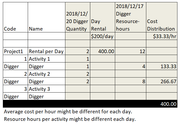
Out of curiosity.How are you
Out of curiosity.
- How are you distributing costs when same digger is shared among several activities on same day?
- I would calculate day rental and distribute cost among activities per hours used by day on each activity.
- The following figures are an example of quantity used per day, hours distribution and cost distribution.

- 0BLBogdan Leonte ·
Rafael,At the present moment
Rafael,
At the present moment in my country there are several trends:
1. Machines are rented by the day not by the hour
2. Manpower: trade workers are paid by quantity and unskilled labour by hour or by day
3. Own resources (employes) which are paid by the hour
Thus,
When I plan and create the project model I take into consideration all of the above.
Unskilled labour which are paid by the hour/day I usually don't asign them to Multi-Resources because it is very hard to quantify their workload so I asign them to a hammock.
Regarding your curiosity, the model you presented doesn't have issues because activities have round durations (3 days, 5 days) so I can model with hourly costs.
The issue I have is with equipment which may finish the job in the middle of the day but ar payed for the whole day.
For resources that are paid hourly I can easily quantify non-productive time with a hammock to which I asign them and set it to variable workload, quantity of asigment = max number of resource, minimal workload is set to 0, then I un-check the „minimize parallel activities” in the Resource Contrained Scheduling Options.
Here is an example created by Spider Team: http://www.spiderproject.com/ru/index.php/spabout/samples/27-resource/83-staypay.
Here is a model based on your model, using hammock to calculate cost of manpower on site.
https://i.postimg.cc/cH2Y8wc5/Resources-On-Site.png
Best Regards,
Bogdan - 0AIAnoon Iimos ·
Of course different
Of course different activities have different costs assumptions; Or perhaps similar activities but of different type of materials or situations, but may use exactly the same equipment. i.e. Excavations: Soft or Normal Soil vs. Hard or Stony one. The contractor can maximize his/her profits for normal or soft excavations but not for hard excavations. Did I understand you right Rafael? - 0BLBogdan Leonte ·
Rafael,You are right, my
Rafael,
You are right, my interest in this topic si to better and more realistically estimate future costs in order to perform an analysis between what we pay vs what we get paid for. The way you do it (wait for accounting) only let's you see the past. Also you may deal with large projects +10 mil, while I deal with small projects around 500k, for which the schedules are very short 1-3 months, for these projects the ability to model costs per day is very important because we must maximize the use of equipment.
Google translate does a pretty good job at translating the page in Russian, the image I posted is similar to the sample project in Russian.
You make a Hammock from the start of the project to the end of the project (link it to stat/finish milestone) and assign all resources for which you like to capture idle time and idle costs, then assign the maximum quantity you have at your disposal, and check the variable workload option and set the minimum workload to 0. In the Scheduling with Resource Constraints uncheck (by default it is cheked) the Minimize parallel activities and run the Resource Constrained Scheduling, the hammock will only keep idle time of the resources and quantify that idle time into costs.
Here a very basic example of optimization:
1. Resource: Digger; maximum number: 4
2. 3 Activities, each has assigned a different number of diggersResult: 120 of idle hours if all 4 Diggers are kept on site; Total Cost: 24k

https://i.postimg.cc/zDPz9QTn/Original-Calculation.png
Optimization: By assigning 4 diggers to all activities, you will get no idle time and shorter duration

https://i.postimg.cc/661ZYY3P/Optimization-Calculation.png
With this model and the ability to calculate costs/day without waiting for accounting is very valuble for forward looking and estimatig total project costs.
Hope I was clear with this example.
Best regards,
Bogdan - 0RDRafael Davila ·
Bodgan, In my country
Bodgan,
In my country machines are usually rented by the day. The rental calculations are per day while resource usage might be less than a full day. Same resource can be shared on different activities same day, different hours on each activity and total resource usage might be less than a day. Our activities can start/finish at middle of the day and do not need to have whole day durations. Our rental calculations are per day while our cost distribution is per hours on each activity each day, we distribute the rental according to hours used per activity each day.
My question is not about the calculation of rental per day or about at what time of day resource usage started or finished as it does not matter to rental calculations, for rental what matter is if resource was used that day, if used even if 1.25 hours hour we pay full day, the issue then is about the distribution of cost/activity. We distribute actual as well as idle time within the activities that required the equipment. I saw no reference in your post about resource hours distributions per day per activity for cost distribution and therefore my question.
In our country for accounting we use accounting software, for scheduling we use several scheduling software depending on what the client requires. We make the rental distributions after receiving the rental bill, preferably we use the labor time cards that distribute the hours the equipment operator worked each day on the different activities at times it is a guesstimate. For us it does not make any sense to use the scheduling software for our accounting.
My curiosity is because we use the scheduling software as a forward looking tool that can include cost estimates and their distributions. Accounting sofware will not give us such forward looking. What you are doing is of interest as a way to get better forward looking reports. In my schedule examples dealing with cost, with a few exceptions, you will only see forward looking discussions.
- Spider example is in Russian, I know no Russian, English a little, Spanish is my language.
- The images are of low quality, annoying to the eye.
Best Regards,
Rafael
- 0BLBogdan Leonte ·
I think I did not make myself
I think I did not make myself clear in the post, my appologies for that.
1. I agree with you, schedule is for the future, accounting is for the past.
2. No way is it a good ideea to use schedules for accounting.
3. The issue discussed was how to create the project model in order to capture costs as close to reality as possible in order to be able to analize project cost vs project price, nothing less nothing more.
4. Actual data will be entered and corrected if needed.
5. I have read the document you posted some time ago when you posted it on another topic (thank you for that, it is most insigthful) and agree with it's content.
Hope now everything is clear.
Best regards,
Bogdan - 0RDRafael Davila ·
The way we do it accounting
The way we do it accounting lets us see the past, scheduling lets us see the future.
We do not have the urge to duplicate accounting effort to see the past. Frequently accounting data becomes available after activity finishes; this alone would create hundreds out-of-sequence issues if using scheduling for accounting. Estimating accounting data at schedule update will require future corrections when finally true data becomes available, the accounting details are so many this is not practical.
Not even for billings we use the schedule because of out-of-sequence problems. For billings we use Excel, easier for contractor as well as client and architect for their review and approval where there are no out-of-sequence issues. The following reference illustrates in detail what a mess if using schedule as a billing tool.
The Great Divorce: Cost Loaded Schedule Updating
By the way at home equipment rental can be by the day, by the week or by the month. If by the day only days matter for billings irrespective of hours per day, if by the weeks only weeks, if by the month only months. If returned earlier than the rental period there are adjustment rules. If rented by the week but used more than 3 days full week rate still applies, if less than 3 days then weely rate divided by 3 is applied for each day. Each vendor might have their own rules as described in their rental agreement. How you model rental if by the month for some supplier while if by the week for other will be interesting.
- 0AIAnoon Iimos ·
Sometimes conclusions were
Sometimes conclusions were easily derived from wrong assumptions (very obvious from the given figures or examples). Forward looking Schedules were usually done using wrongly assumed "short-cuts", thus, always lead to out of sequence activities and or progress. While you can do an accurate "Accounting" working backwards; Why you cannot do an accurate Schedule looking forwards, when the assumptions (or estimations) and the facts should have NO difference at all? I for one do not agree (may never matter to you anyway). - 0AIAnoon Iimos ·
Vladimir, I do not agree that
Vladimir, I do not agree that forward looking scheduling is very difficult or can never be done correctly (in terms of costs); While accounting processes is always accurate. Where do accounting gets the data (or who feeds them the facts) by the way? Accountants or Auditors cannot determine "Physical Progress" all by themselves. They shall always rely on data given by Cost Engineers, Planners or Schedulers. So how do most people (if not all) say that accounting data is always right or reliable? And also I don't agree with the reference linked by Rafael. I hope you understand now? :-) - 0VLVladimir Liberzon ·
Anoon,When we plan the future
Anoon,
When we plan the future we take into account risks and uncertainty that do not exist in the past. For example we may allow for certain numbers of the rain days that may actually happen or not, we expect to buy materials for certain price that may actually change, etc. So our planned values are always probable but not certain. Actual data can be measured and confirmed.
Besides we estimate project status and reschedule the remaining work basing on data collected on construction sites. Accounting is usually based on the documented data and accepted works and this data are different. What is done and what is already accepted rarely coincide.
- 0AIAnoon Iimos ·
Vladimir, Sorry, but for me,
Vladimir, Sorry, but for me, accounting work(s) is only based on "Official Receipts" (a real life fact). "Work Acceptance" is a job for QA/QC. Planned and Real Construction Costs are for Cost Engineers and or Quantity Surveyors. And of course Schedules and actual progress are for Planners and Schedulers, but most of the time doing multi-tasking, and may also cover the scope of Cost Engineers and Quantity Surveyors (that's a real life fact as well). So why the works of Planners are always wrong; and Accounting are always right? Can they not both right at the same time? (When accounting data always rely on Planners for percentage progress or actual progress)? - 0VLVladimir Liberzon ·
Anoon,in my country "official
Anoon,
in my country "official receipts" can be issued only after "work acceptance".
Our planners (we do not have "schedulers") plan both schedules and budgets.
Management decisions are justified if they are profitable. So it is not right to manage schedules and costs separately. Besides it is necessary to know what expenses are expected in each month. So project model includes resources and costs.
But accounting is not based on planner's data and is always late.
- 0AIAnoon Iimos ·
Vladimir, The "Culprit" is
Vladimir, The "Culprit" is never the "sophisticated software" nor the "out-of-sequence activities" For me, to separate "time" & "cost" is NOT planning. If this is the case, then no need for Planners or Cost Engineers. Companies shall only employ so-called schedulers and accountants. Again, the culprit is not the software nor OOS activities, but simply your Plan or Schedule in the first place. WHY? Builders or field personnel can never do "out-of-sequence" activities (OOS only exists in Schedules and never in reality). I might suggest to ban "Retained Logic" in the schedules and use only "Progress Override". Try to model your schedule exactly how you would do the works on site and you can never go wrong. This is where your "fragments library" will stand-out. Again, there are no "Short-cuts" for good Planning and Scheduling. One thing that hinders good Planning is the "absence of details", which resulted to most people doing short-cuts. - 0VLVladimir Liberzon ·
Anoon, I agree with your
Anoon, I agree with your statements but out of sequience in resource constrained schedule can happen without violation of work technology.
The software may suggest certain order of work for constrained resources and for some reason this order may be violated. This is not good if the software calculated the best schedule and may lead to substantial delays.
- 0AIAnoon Iimos ·
Vladimir, Yes, nothing is
Vladimir, Yes, nothing is certain or perfect on any given situation. So you need to keep the balance as practicably as possible. Schedules are intended to keep the records regardless of conditions or actual situations. Out of sequence activities and or resources cannot be seen in real construction. Schedules do not govern real construction, but Quality Control (and Safety) governs the real timing of works (I guess most people don't realize this). And Quality Assurance ensures delivery and acceptance of real works or deliverables (again, not the Schedule). However, of course Schedule(s) is the absolute guide or map (or Headlights) for doing the works. If you go astray, then who's to blame? HAPPY CHRISTMAS TO ALL! - 0VLVladimir Liberzon ·
Anoon,I do not agree with
Anoon,
I do not agree with your statement that "Schedules do not govern real construction."
In my practice project schedule creates the plans for every shift and out of sequence performance may lead to some penalties to site managers. Project schedule determines the optimal order of activity execution that shall be followed.
I join to your HAPPY CHRISTMAS TO ALL!
- 0BLBogdan Leonte ·
Vladimir, Rafael,I have
Vladimir, Rafael,
I have managed to create a procedure for calculating Costs/Day for resources that are payed by day:
Input Data:
User Fields
1. Cost per Day - Assignment value is the value of Resource - This represents the cost/day for resources and it can be filled either in the resource table or OBS; also option Auto-fill in performance input is checked
2. Duration [Cost/Day] - Calculated by formula if (Cost_Day != '', NumDays, '') in the resource assignments table;
Formulas:
1. One for Labor Cost/Day and one for Machinery Cost/Day: c_fix_Cost_Man_Exec = if (Cost_Day != '' and DurPlanD != '' and Type = 'Labor', Cost_Day * Dur_Cost_Day * NumPlan, c_fix_Cost_Man_Exec), where c_fix_Cost_Man_Exec is the cost component of Labor, this formula calculates the remaining cost for resources that are payed by day
2. One for Labor Cost/Day and one for Machinery Cost/Day: c_aac_Cost_Man_Exec = if (Cost_Day !='' and Type = 'Labor', Cost_Day * Dur_Cost_Day * Number, c_aac_Cost_Man_Exec), where c_aac_Cost_Man_Exec is the actual cost of Labor in the performance archive, this formula will be applied in the Performance archive after actual data input is tranfered
Procedure:
In the actual data input table I enter the number of days in the Duration [Cost/Day] [Consumed by Period] at the assignment level and the Quantity [Actual], then you Transfer the actual data input into the next version, then the second formula is applied in the Performance archive.
Howerver I have one problem with this solution: the actual costs of the resources aren't transfered at the activity level resulting in different actual costs between activity and resources that are payed/day.
Do you have a solution to my final problem?
Best regards,
Bogdan - 0BLBogdan Leonte ·
Rafael, VladimirI agree with
Rafael, Vladimir
I agree with you regarding the partial workload of resources in the same day, in sense that my approach would result in wrong calculation and basically doubling, tripling the cost of resources at the assignment level.
This is the reason why, the field Duration [Cost/Day] would only be calculated for resources that are payed by day; in order to be able to filter them easily and find these overlaps.
The problem itself is a bit tricky, however from my experience it's better to overestimate costs than underestimate them.
The main reason for using such an approach is that I would like to be able to track actual resource hours and productivity while capturing true costs.
The problem I have in the performance archive is that after applying the formula to the performance archive the costs of resources isn't tranfered to the activity level, as shown in the table below:
Activity code Resource code Activity name Resource name Labor Costs [Actual] Machinery Costs [Actual] 1 Start 3 Activity 3 1600 3 Lab_Cost_Hour Activity 3 Labor - Cost/Hour 100 3 Lab_Cost_Day Activity 3 Labor - Cost/Day 1000 4 Activity 4 700 4 Lab_Cost_Hour Activity 4 Labor - Cost/Hour 700 6 Activity 6 83,84 6 Scafonding_Cost_Day Activity 6 Scafolding - Cost/Day (24h) 400 The only solution I have to this problem is to export the table in excel and via a macro to calculate the actual cost of the activity by summing the resource costs with a loop (easily done) and then just copy-paste the results in the performance archive.
Another way I thought to do this is to create a calendar with 1 hour/work day and assign it to the resources payed by day and to track actual hours using a user field. The productivity of these resources will represent the productivity for 1 day instead of 1 hour.
Best regards,
Bogdan - 0RDRafael Davila ·
On a construction job, every
On a construction job, every day you have many cost components you must account for otherwise your cost database might be invalidated, you might have:
- Different concrete quantities for different activities, some deliveries with overtime charges.
- Some activities work only on regular time, some on regular plus overtime, other activities a combination of regular and overtime, each day a different distribution.
Time cards for CPM data entry can be a nightmare; hours shall be distributed per cost code as well as per CPM activities.
Time cards for Job Costing are easy; hours are distributed by cost code only.
- Equipment not used that day but based on rental per week or month.
- Margins in construction jobs is small, wrong distribution and you got it wrong.
- Job Costing Modules for Accounting Software do not get into the granularity extremes CPM Software do. When entering cost data in CPM Software you must enter the costs per cost code and activity codes while in Accounting Software you enter costs per cost codes only. This makes a huge difference in data entry.
Imagine small purchases like nails to be used in many activities.
Imagine you received a truckload of Gypsum Board Panels.
In a Job Costing system usually you would do a single entry for a single cost code, in CPM software you must figure out the distribution per activity and make many entries, one for each activity you figured out the distribution.
- In CPM software when activities finish you cannot add late cost entries; by the same token you cannot add cost entries for not started activities.
- Accounting Software goes to the penny; no cost entry is ever missed.
- Job Costing gives you true total cost expenditures, unit cost to date as well as production rates.
Unit cost makes the cost reports more meaningful.
- In order to track production rates you must enter production quantities for each cost code entry.
- CPM software only gives you an approximation to total cost because much of it is based on fictional data.How are you planning to account for the above? A short list that in no way includes all possibilities you might encounter.
- 0VLVladimir Liberzon ·
Bogdan,it is possible to
Bogdan,
it is possible to create formula that will summarise values from assignment fields but it will not solve the problem.
As I wrote earlier - if some resource did several activities in one day then it is not clear how to calculate the costs of these assignments.
For resources that are paid daily we usually create hammock activities that last from the first to the last resource usage.
Resource rate we assign to this hammock that have calendar where only first minute of work day is working. Daily rate is assigned to this minute.
- 0BLBogdan Leonte ·
Rafael,I don't intend to use
Rafael,
I don't intend to use CPM software for accounting instead of accounting software. I don't even enter materials that are below 3% of the total value of materials in the CPM model; as you said there are a lot of small materials that are used every day and it is a waste of time to keep track of them via CPM models.
Vladimir,
You are right in regard of the formulas I tested; and maybe with the whole ideea of modeling of daily costs, however I still want to try a different approach than the one you suggested and if that also fails I will yield.
Thank you for your input!
Best regards,
Bogdan - 0BLBogdan Leonte ·
Vladimir,If I understoond
Vladimir,
If I understoond correctly your approach:
1. Use hammocks with 1 h/day calendar;
2. Assign costs to this hammock per hour, where the cost/hour represents the cost/day of the resource;
3. If there are multiple resources than cost/hour (cost/day) will be cost/day x no of resources. Correct?See image below:
My problem with this approach:
1. It assumes a uniform distribution of resources, if you use variable quantity, the method will fail, unless you use multiple hammocks;
2. If resources are removed from site and then brought back, than you need hammocks for each time period;
I think it will complicate the model very much, and I think it is feasible if you have 1-2 resources for a long period of time several months.I would like to get your oppinion on my ideea:
1. Using a hammock to capture idle time and costs, thus adding partial workloads from the activities with idle time captured by hammock you get full day cost;
2. Using milesone and resource production for the supply and removal of resources from site.Where:
(93) Removal of Labor - Bogdan - Has Resource Production - (-2) Labor - Bogdan at the end of the activity
(94) Removal of Backhoe - Bogdan - Has Resource Production - (-1) Backhoe - Bogdan at the end of the activity
(95) Supply of Backhoe - Bogdan - Has Resource Production - (+1) Backhoe - Bogdan at the end of the activity
However there seems to be a problem with this approach in the sense that resource production activities, when leveling, are delayed in order to be able to complete the hammock activity that captures idle costs.
Below is the result after resource leveling:
The expected result (edited in PDF):
Explanations:
Resource: Labor - Bogdan: the workload on the first 2 days is below 100%, first day 70%, second day 30%, thus the hammock should capture idel time and costs, after milestone (93) Removal of Labor - Bogdan the resource should be removed and the hammock should not display the Labor - Bogdan resource anymore;
Resource: Backhoe - Bogdan: similar to the Labor resource the first 2 days the workload is below 100%, after removal of the backhoe, hammock shouldn't capture resource idle time, after backhoe supply hammock also shouldn't capture idle time since the workload for each activity is 100% and the resource is leveled, activity 8 being delayed by activity 7.
If this method would work properly users would be able to:
1. Use a single hamock to capture idle time and costs, thus costs/day
2. Distribute costs to activities
3. Manage resource supply/removal similar to material supply
What do you tinck, do you tinck this is a better solution? Would if be possible to make the leveling algorithm in such a way that hammocks have the lowest priority when leveling instead of resource production activities?
Best regards,Bogdan - 0BLBogdan Leonte ·
Vladimir,I made a mistake
Vladimir,
I made a mistake when I setup the leveling on the project presented.
I forgot to set minimal quantity to zero for the resources on the hammock; now the model looks good.
I also made a correction in my initial model, forgot to setup the calendar with 1h/day to an activity.Now let's compare the 2 solutions:
1. Your option:
a. Captures costs/day for the 2 resources
b. Has 3 hammocks
c. Has no distribution of costs assigned to activities2. My option:
a. Captures costs/day for the 2 resources
b. Captures Idle Time and Idle Costs
c. Has 1 hammock and 3 milestones for supply+removal of resources (so 1 more activity than yours)
d. Has distribution of costs assigned to activitiesSee below:
Does my model have any flaws? This is the question.
Kind regards,
Bogdan - 0VLVladimir Liberzon ·
Bogdan,you suggested to
Bogdan,
you suggested to collect resource idle times on the hammock activity.
We do the same when there are different rates for work time and idle time.
But I did not understand how it helps for calculating costs of resources paid daily and activities where they were used.
- 0BLBogdan Leonte ·
Daily costs are formed from
Daily costs are formed from working times + idle time. A resource that works 2h/day is payed for the full day. Say it costs 200 money/day; by dividing 200 to number of hours/day you get the cost/hour. If you capture idle time of reource you capture the daily cost. This of course doesn't work if activity duration isn't in whole units (2.25 days). It's not perfect but I suppose, in the end, that both solutions have pro's and con's. In the end it depends on the user. I understood your solution and will consider it for some cases, but I belive it can complicate the project model. Best regards, Bogdan - 0VLVladimir Liberzon ·
Bogdan,in our discussion I
Bogdan,
in our discussion I suggested an example:
resource that paid daily did 5 activities in one day and besides had some idle time. What is the cost of each activity?
You suggested to transform daily cost to hour cost. Once again - what if resource worked only 5 minutes on its last work day? If you want to distribute resource cost between activities how do you suggest to distribute its idle time?
About the model that I suggested.
You rememer that you can create any number of WBS and some of them may be not full.
So yes, adding hammocks will complicate the model but you can create and work with WBS where these hammocks will be hidden.
- 0BLBogdan Leonte ·
Vladimir,With the risk of
Vladimir,
With the risk of getting off topic idle times and costs, depending on country legislation, may be considered overhead costs. In my country idle times and costs are considered overhead costs, according to some goverment regulations, thus national norms consider only the working times of resources. But this is a little off topic, now back to our debate.
Regarding: „resource that paid daily did 5 activities in one day and besides had some idle time. What is the cost of each activity?”
Using your method you cannot determine the cost of each activity, you determine the cost of the resource, no matter the workload.
Using my method I determine the cost of the activity (number of hours x hourly rate) + idle costs (wich I consider overhead and don't neet to assign to an activity).
Resources payed daily have 3 possibilities:
1. Work every day less than the full day and get paied for the whole day;
2. Work every day the whole day, finish in the middle of the day and are no longer needed, they get paied for the whole last day;
3. Both 1+2.Getting passed the complication of the model and multiple WBS structures (all fine with me) your method handles points 1-3 no argument there, but you cannot distribute the cost of resources to activities, unless done in a spreadsheet based or using a formula.
I don't understand on what aspect you do not agree with my suggestion. It deals with points 1 & 2, for the 3rd (1+2) the user can round activity durations to whole units (because if an activity has a calculated duration of 20,125 days it doen't matter if you round it to 20, actual data may pe 19 or 25), it captures activity costs and overhead costs.
This toppic has many aspects, for example some subcontractors want to be paied/day but work no more than 9 hours and if they work more than 9 hours they want to be paied extra, for example.
From my point of view the project model has to be 90-95% accurate, yet easy enough to create, understand, track, change; isn't this the same as you preffering to use 3 Scenarios over Monte Carol?
- 0VLVladimir Liberzon ·
Bogdan,There is no problem
Bogdan,
There is no problem with your approach if resources are paid for work hours only.
But there are problems if they are paid for work days.
Let's suppose resotce rate is 80 moneys per day or 10 per hour (if to divide as you ptoposed.
Let's consider only one day of resource work. Resource spent 1 hour on activity 1, 15 minutes on activity 2 and 2 hours on activity 3. The rest was idle time. The cost of this day calculated using hour cost is 32.5 moneys, not 80 moneys. I don't understand what did you propose for automatic correction of the hour price for each day of the project.
Besides, as the result you will get different costs of the same activities performed at different times.
Without correction project cost will be higher than the sum of activity costs. And if first use of the resource happens in the middle of the work day and ends at the beginning of the last work the resuly will be wrong.
I know that estimaring usually ignores idle time. But we hope that our users will use Spider for managing their own expenses.
- 0BLBogdan Leonte ·
Ok Vladimir,I yield, there
Ok Vladimir,
I yield, there are some cases, like the one you mentioned where my approach cannot capture the daily costs.
But I am still not a fan of the only solution (the one you proposed) because if you have many resources that are payed by day then you complicate the model; but it is still easier than what Rafael proposed (keeping a spreadsheet in parallel with the schedule).
I understand that the schedule is only an estimation, a mathematical model, that assumes some simplifications.
Best regards,
Bogdan - 0RDRafael Davila ·
Vladimir and Bogdan,The
Vladimir and Bogdan,
The following image displays some of the cost & production reports we are used to.
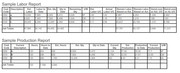
While Project Managers will pay attention to cost & production reports the activities are managed at the jobsite by field supervisors who closely track production rates instead of costs. Keeping track of estimate vs. per period and to-date production rates is fundamental to cost control.I am interested on how to calculate and report production rates for current period and production rates to-date using Spider Project.
Best Regards,
Rafael
- 0RDRafael Davila ·
Bogdan,The distribution of
Bogdan,
The distribution of actual costs can easily become complicated for CPM software while Job Costing Modules can deal with the distributions with fewer complications. The following image can represent a common resource costing scenario.
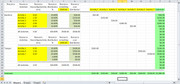
How you will get the distribution if using your formulas?
Best Regards,
Rafael - 0VLVladimir Liberzon ·
Rafael,if actual data were
Rafael,
if actual data were entered correctly it is sufficient to apply formula Actual Volume / Actual Duration shows actual production rate.
Remember that Spider Project can create reports for any period. And applying formula for the period data you will get production rate for the period.
I am not sure that understood all parameters shown in your sample reports, but it looks like all of them can be provided by Spider Proect.
- 0VLVladimir Liberzon ·
Rafael,we define different
Rafael,
we define different activities if they are performed by different crews.
Project model usually includes soft dependencies that define the order of the crews movements (from the right to the left or vice versa? or from both sides, etc.).
We also use strict dependencies but they do not work in certain cases.
If we do not want that some crew will be moved to other area before some event we use approach similar to iusing space constraints.
- 0RDRafael Davila ·
Vladimir,Some activities
Vladimir,
Some activities might have several volumes of work. You might have CMU Masonry Walls; the activity will include CMU installation on first shift as well as tie beams and columns on second shift that must go hand in hand with the progress of the activity. If you split the activity and link them with SS and FF logic the resource leveling can schedule them to happen at different times.
When activity includes several volumes of work how can you get the current production rates for each team?
Footings can be another example of activities that require multiple teams working on different shifts; you might have an excavation team working on the activity the first 2 hours of the day, a reinforcing steel team working next 2 hours and a pouring team working next 1 hour. This we do frequently because of how much it rains here in the afternoon. If we start at 6 am by 11 am we should have finished with the pour.

- 0VLVladimir Liberzon ·
Rafael,we recommend to create
Rafael,
we recommend to create activities that satisfy following requirements:
- they have certain units of the volume,
- they use certain crews through activity duration,
- productivity of assigned resources are the same,
- their material requirements are the same,
- their unit costs are the same,
- their duration is comparable with schedule analysis period.
- 0RDRafael Davila ·
Rafael, we recommend to
Rafael,
we recommend to create activities that satisfy following requirements:- I do not agree and here is why.
Footings Example: Footings activity with an excavation team working on the activity the first 2 hours of the day, a reinforcing steel team working next 2 hours and a pouring team working next 1 hour. This we do frequently because of how much it rains here in the afternoon. If we start at 6 am by 11 am we should have finished with the pour.
- they have certain units of the volume, => In my Footings example each crew have their own production rate for different volumes of work. We frequently schedule multiple teams working on different activities each team working a different work component. When there is no correlation among the different production rates fixed duration activity type might be a best fit.
- they use certain crews through activity duration, => In my Footings example the reinforcing steel resources are used on other activities during the day, same go with the other resources. Usually we want the crews to be moved to other areas instead of being idle for most of the day.
- productivity of assigned resources are the same, => In my Footings example resources work on different work components, different productivity for each work component.
- their material requirements are the same,=> In my footings example the materials requirements for the different work components are different.
- their unit costs are the same, => In my Footings example the unit cost for excavation, reinforcing steel installation and concrete pouring are different, so different they do not share the units.
- their duration is comparable with schedule analysis period. => In my Footings example the schedule is analyzed by the Client on a monthly basis, the PM looks at progress on a weekly basis and at times for critical activities on a daily basis. Frequently we update the schedule on a weekly basis plus whenever the unexpected happens and immediate corrective action is necessary plus at the end of the cutoff date as required by the client. Many of our activities start and finish on different periods, it makes no difference if it works on a single period, two or several. I am still wondering if the update period is the whim of the client or whenever it needs to be. We do not force activity duration to a maximum arbitrary duration; initially we set activity duration to whatever it needs to be, in order to be contiguous we do not split it, otherwise leveling might spread apart the activities we need to be contiguous.Best Regards,
Rafael
Log in or join to reply
ProjectControls.com is free to join. Members can post questions, reply, vote and follow discussions.
Existing members: your original username and password still work. Forgot password?