
Resource cost rounding
- Created
- 65
- 12
Hello Vladimir,
Materials in Spider have an option called Discrete Consumtion which rounds up the consumtion of the material (granted the Backload consuption is set to No).
So here is my question, is there a way to do this with resources?
Example:
Backhoe is paied by the day even if it works for 2 hours or for 8. I would like to know if there is a way to take this into account when calculating costs.
Best regards,
Bogdan
65 replies
Oldest first- 0VLVladimir Liberzon ·
Rafael,we create separate
Rafael,
we create separate activities for excavation, reinforcing and pouring.
When I wrote about analysis period it meant the upper limit with one exception - when volume of work done and remained can be easily measured.
There are many reasons for selecting detailed schedules: different resources work at different times, rain will delay pouring but permits reinforcing, reinforcement can start at one day and finish next day, but pouring cannot be interrupted, etc.
The schedule that we will use looks like below with work day start at 6:00 and finish at 14:30.
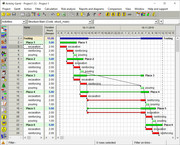
With this representation in another WBS
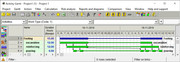
By the way, performance analysis is made before each PM team meeting that here happen at least once in a week.
- 0RDRafael Davila ·
I find it better if a single
I find it better if a single activity for this group of footings allows me to account for resource leveling instead of 18 activities.
If we have 12 buildings each divided in 2 sections each of 6 pours that makes 12x2x6 = 144 pours x 3 activities/pour = 432 activities. If using 1 activity to represent each section we will have 12x2 = 24 activities , a reduction of 432-24 = 408 activities.
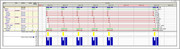
Variable quantities is what will make it possible to make better use of the resources that can be shared the same day with other activities.
- 0VLVladimir Liberzon ·
Rafael,is it true that your
Rafael,
is it true that your construction work day lasts 5 hours only, excavation crew works 2 hours, reinforcement crew works 2 hours, and pouring crew works 1 hour per day? I think that No.
If they work the way I understand and for some reason pouring was not done it does not mean that excavating and reinforcing do not proceed. Actually excavation and reinforcing may be represented as one activity with volume lag between them, pouring dependency is more complicated because it shall be continuous for portions that were selected and it depends on the weather more than other jobs. If to model this my proposal will work more correctly.
Besides, we shall not plan that the work will be done at certain time like from 10 to 11 because any delays may happen and the same job may be done from 10:15 to 11:15.
- 0VLVladimir Liberzon ·
Rafael,I still wonder if
Rafael,
I still wonder if excavation crew works 2 hours per day, reinforcing crew works 2 hours per day and pouring crew may work or not depending on the weather but if work then only 1 hour per day.
I understood that your footing consists of several divisions that are done one after another, pouring may be done for whole divisions only, that excavation crews and reinforcing crews are different and can work in parallel though at different divisions. Pouring crew can also work in parallel with others and requires less number of workers (variable assignments will be useful here).
So we don't know the exact time when division excavating will be finished and reinforcement may start, We may plan that it will take 2 hours but in fact may take more or less. And so I don't understand resource assignments for certain time as in your example, for certain volume yes.
I don't discuss contingency reserves, just planning resource work.
- 0RDRafael Davila ·
My typical construction
My typical construction workday is 8 hours as shown in the provided schedules, it is footing activities that are planned to take 5 hours a day. Because of our rain pattern we do not leave open footings overnight, for mat foundations we place 2in lean concrete base and an electic water pump to keep excavation dry.
No schedule goes exactly as planned therefore we plan with this contingency in mind, that at times it rains in the morning is a contingency we must consider. Contingency planning can take many forms; can be added time to activities, this usually I do not like unless it is not significant. Contingency planning can be having spare resources you do not include in plans such as having extra labor to account for vacations, unplanned work, sick days etc. Targeting for early completion to increase probabilities of finishing on time is another contingency strategy, this is my favorite for construction works. For other type of works adding activity time is not always a sin.
For footings pouring crews are laborer, anyone who can work a concrete vibrator can do it, these laborer then move to other activities just that in my example for simplicity I only included rodmen.
Updating is easy, remaining work is planned the same way, pouring at the 5th hour, if it rained on prior day(s) then it will still take 1 hour to pour several days of footings, in one hour you can pour a lot of concrete for footings with the same crew, no need to change plans for remaining days of footings concrete pouring.

For slabs pouring we use separate activity, for walls and columns we plan 8 hours/day with resource loading using partial workloads. I do not recall a single time Spider Project let me down.
Best Regards,
Rafael
- 0VLVladimir Liberzon ·
Hi Rafael,now I understood
Hi Rafael,
now I understood your work pattern.
Here it is different. As I explained in my previous post the whole job is divided into divisions and pouring is done for the whole divisions only and this results in the necessity for discrete planning.
- 0RDRafael Davila ·
In our regular planning for
In our regular planning for similar jobs, we pour concrete slabs each day early in the morning because of rain pattern and schedule them as individual activities, preparation for slabs take days and schedule them as individual activities. For some locations we excavate footings early for 2 hours every day, then place reinforcing steel on whatever is ready and pour by mid-day whatever is ready as to avoid rain and not to leave open excavations during the night, we schedule them in groups as a single activity that spans several days. We form walls using flying forms every afternoon and pour these walls late in the afternoon, we schedule them as groups, we schedule them as a single activity that spans several days.
I do not recall a single such job with 3 activities/day for each footing group, such granularity is unacceptable to my clients. Many go as far as rejecting resource loading.
I still wonder if excavation crew works 2 hours per day, reinforcing crew works 2 hours per day and pouring crew may work or not depending on the weather but if work then only 1 hour per day [then next day continue with 1 hour excavation to finish the required 2 hours, then 2 hours reinforcing steel and 1 hour concrete pouring].
I understood that your footing consists of several divisions that are done one after another, [Some divisions or group of footings are planned one after another but might be independent of other groups] pouring may be done for whole divisions only [pouring is done for a portion of each division each day until the division finishes], that excavation crews and reinforcing crews are different [yes they are different] and can work in parallel though at different divisions [we do not plan them as partial workloads so each crew work on only one division at a time].
Pouring crew can also work in parallel with others [we do not plan them as partial workloads so they work on only one division at a time] and requires less number of workers (variable assignments will be useful here) [resource quantities are fixed and at 100% workload, variable quantities and workloads is for activities that can use them when idle].
So we don't know the exact time when division excavating will be finished [within first 2 hours of last day of activity execution] and reinforcement may start [at 2nd hour of each day while activity is not finished]. We may plan that it will take 2 hours but in fact may take more or less [will take no more than 2 hours per day as per allotted time]. And so I don't understand resource assignments for certain time as in your example, for certain volume yes [each crew will have a specific time slot and next crew will work on what prior crew finished on that day].
Best Regards,
Rafael
- 0BLBogdan Leonte ·
Rafael,you asked „When
Rafael,
you asked „When activity includes several volumes of work how can you get the current production rates for each team?”
Why not do the following:
Create 3 user fields (UF): Volume [UF], Unit of Volume [UF], Productivity [UF]. You can enter Volume and Unit of Volume at the Team level and then using a formula Volume / WorkLoadPlan (Resource Hours [Remaining]) and you get the planned productivity.
Also assign an insignificant Load (0.0001) to your 6am-8am, 8am-10am, 10am-11am resources in order not to influence your resource-hours column which is summed at the team level.
Using actual data you can get actual productivity.
Is this what you were looking for?
Best regards,
Bogdan - 0VLVladimir Liberzon ·
Rafael,you can assign
Rafael,
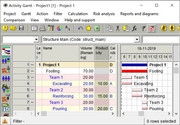
you can assign different volumes for different teams but it will be necessary to create UDF for units of measure.
Activity volume will be the sum and will not make sense but teams (resources) volumes will be right.
Material requirements shall be set for assignments (not activity!)
Look at
- 0RDRafael Davila ·
Bogdan, I am not interested
Bogdan,
I am not interested in the distribution per activity, but a summary per cost code. I am looking for budget labor production rates, current period labor production rates and to-date labor production rates; for hundreds of cost codes as shown in the following figure, showing two of the many reports for costing and production reports we are used.
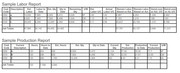
- Any activity out of hundreds or thousands can have multiple cost codes with distributions by LEMSO for labor, equipment, materials, subcontracts and other.
- Same cost code with distributions by LEMSO can be assigned to hundreds or thousands of activities.
I do not find this approach practical, is too complicated, data entry looks to be a nightmare even when only for production reports. When required to use other CPM software by client as it is common at home it is not transferable.
Best Regards,
Rafael
- 0RDRafael Davila ·
Vladimir,Do you mean using
Vladimir,
- Do you mean using multi-resources and volume fixed for teams?
- How do you get hours for labor resources only?
Maybe a tabular report will address both.
I believe controlling cost by looking at labor production rates is a very good approach. Labor costs have the highest variance and on average represent 40% of the direct construction costs and this you can get at the jobsite with precise quantities on real time.
Best Regards,
Rafael
P.S. I do not want Spider to get too complicated with regard to these reports, I appreciate Spider Project for modeling remaining work, here it provides more than I ever needed, but I know if I ever need more it is already available without extra learning effort.
- 0VLVladimir Liberzon ·
Rafael,yes set fixed volumes
Rafael,
yes set fixed volumes for assigned teams, set calendars for assigned teams, set resource productivity for resource assignments, create UDF for volume units and set them for team volumes, define material requirements for assignments (I prefer per assignment volume unit), set resource costs or unit costs or both.
In Spider Project you can create Resource Centers. I suggest to create Resource Center Labor and include there all labor resources. As the result you will get any report on the resource center including cumulative labor hours.
- 0RDRafael Davila ·
Vladimir, I will be
Vladimir,
I will be experimenting your suggestion, seems this is what I am looking for.
I would like to add I agree with your assessment about the necessity for discrete planning for some activities. I believe granularity shall be what best fit the needs of your model.
I do not believe you can figure it out for the following scenario without discrete planning for resources and activities. At times crane is reserved for a single activity at specific times of the day but at other times it is shared. Crane 1 is needed for section A, both cranes are needed for section B and crane 2 is needed for section C. Communicating such detailed planning is essential for planning as well as to train new field supervisors.


Best Regards,
Rafael
- 0VLVladimir Liberzon ·
Rafael,I do not understand if
Rafael,
I do not understand if there is a question in your post.
I don't see any problem in your scenario.
Just assign the skill Tower Crane to activities of section B.
Skill consists of two multiresources consisting of the crane and its operator.
Spider Project will select which crane to use on any activity.
- 0RDRafael Davila ·
Vladimir,My post is just a
Vladimir,
My post is just a statement of agreement that granularity is frequently required.
Skill assignment is not the same as partial workloads:
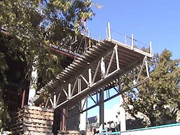
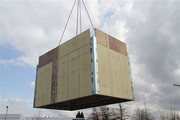
- For elevated slab flying forms the two cranes are required to do work on section B as in some areas of section B crane 1 will not be able to clear slab perimeter and take out elevated slab forms. In the sketch you can see a rectangle outside of the slab perimeter mean to represent elevated slab flying form, only crane 1 can get it out. The rightmost forms in section B can only be moved to next level by crane 2. The leftmost forms in section B can only be moved to next level by crane 1.
- Wall forms for elevator shaft(s), usually at the center of the building, might be a heavy prefab for the interior faces; therefore because of their shape, weight and additional stripping force it is preferred to handle these with the crane that is closer.
- Safety is always a major concern when there is a possibility of crane cables colliding. A way to keep it under control is to have anti collision system and limit to 3 the quadrants each crane works at any given time. When working on section B the two quadrants the two cranes share can be alternated in coordination with the superintendent. This is another reason to plan 2 cranes with partial workloads.
Best Regards,
Rafael
Log in or join to reply
ProjectControls.com is free to join. Members can post questions, reply, vote and follow discussions.
Existing members: your original username and password still work. Forgot password?